

Service charge disputes: your rights, evidence and options in 2026
October 12, 2026
A defect, missed completion date or disputed promise can become costly if you choose the wrong response. A new build property dispute solicitor can review the contract, evidence and outcome you want before you commit to a route that could affect your position.
It can be difficult to know whether a problem justifies legal action, particularly when a developer, warranty provider or complaints process is also involved. The right strategy depends on what was agreed, what has gone wrong, what evidence is available and what you want to achieve. Preserve correspondence, photographs, inspection reports and notes of conversations. Get advice on any potential time limits before they become an issue.
This article explains how a solicitor can assess the dispute and weigh complaint, warranty, negotiation and formal legal routes. It also sets out what to organise before seeking advice, so WYN Legal can assess your position and help shape a proportionate strategy.
Key Takeaways
- A new-build disagreement does not automatically require court action. The right route depends on the legal issues, evidence, objectives and risks.
- A new build property dispute solicitor can review the contract, specifications, variations and correspondence to assess the strength and direction of your position.
- Developer complaints, warranty processes and formal legal action have different purposes and limitations.
- Prepare a clear chronology, preserve original records and distinguish what you directly observed from what you assume.
- WYN Legal advises on new-build disputes, assessing available routes against your objectives and evidence.
When a new-build property dispute solicitor can add strategic value
A new-build property dispute solicitor advises on disagreements arising from a newly built property. The role is not to turn every concern into a court claim. It is to identify the legal issues, test the evidence, establish the outcome that matters to you and consider a proportionate way forward.
A dispute might concern whether a property matches its agreed specification, who is responsible for an alleged defect, a delay, a statement made during the sale or an issue affecting shared parts of a development. The relevant parties may include the developer, a contractor or another organisation, depending on the agreements and the issue.
The existence of a problem does not, by itself, establish responsibility. The contract and related documents, who made a particular representation, what work was carried out and the evidence connecting the issue to an alleged failure all matter. A solicitor can distinguish a practical snagging concern from a potential claim, then explain the strengths, uncertainties and risks without treating litigation as inevitable.
Legal rights and procedures depend on the contract, the facts and the applicable UK jurisdiction. The linked explanation of Builder’s remedy concerns a distinct planning mechanism, not a general route for resolving a buyer’s new-build complaint. Similar terminology does not mean the same legal framework applies.
Which new-build disagreements may need legal assessment?
Not every snag or disagreement justifies a legal claim. A concern may be minor, readily resolved or unsupported by evidence. A more serious dispute can arise when the parties disagree about what was promised, who is responsible or what remedy is appropriate.
Legal assessment can be useful where the issue involves a departure from the agreed specification, an alleged defect that has not been addressed, a delay with practical consequences or a disputed representation. A solicitor can examine the terms, parties and supporting material before advising whether a legal route is viable and proportionate.
When does a new-build property dispute become a legal matter?
A dispute may need legal attention when responsibility is denied, a proposed remedy is rejected or the consequences are financially material. A prolonged disagreement can also make it harder to keep a clear record of what was reported, when it was raised and how the response developed.
A snag is a reported issue; it becomes a contested legal dispute when responsibility, obligation or remedy is actively disputed. Early advice can clarify the claim, identify evidence gaps and define a practical objective, such as corrective work, another remedy or a formal step. A new build property dispute solicitor can assess the risks against the outcome you seek, rather than allowing frustration to dictate the next move.
How a solicitor assesses the contract, evidence and potential routes
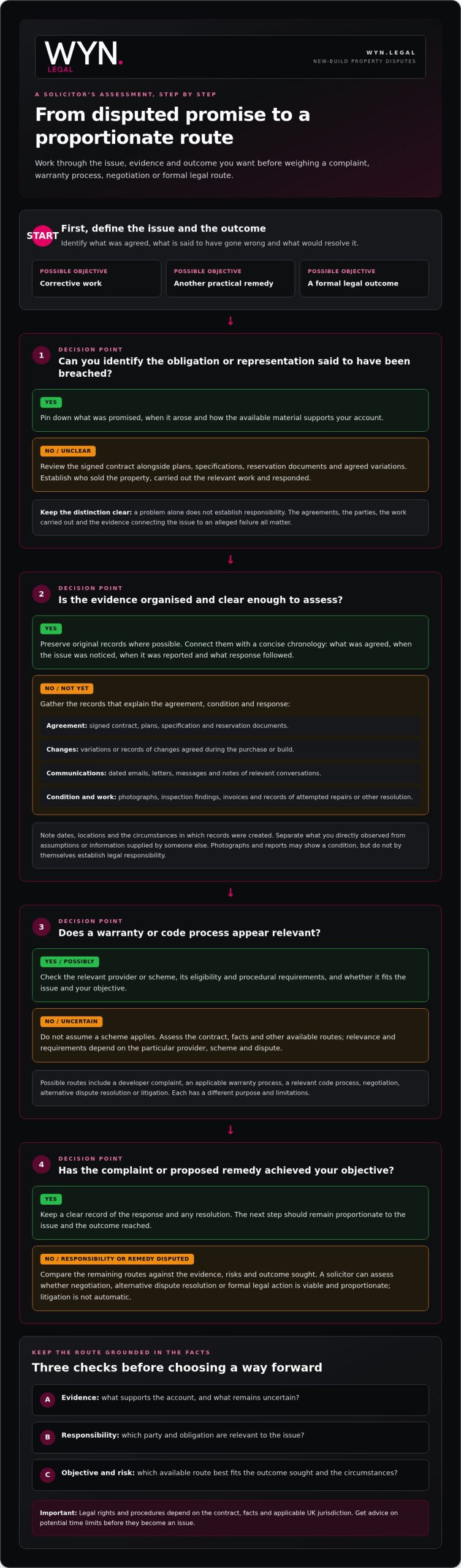
A sound assessment is methodical. A new build property dispute solicitor establishes who made the relevant promise, who is alleged to have failed to meet it, what documents govern the relationship and what outcome you want. This helps distinguish a potentially provable contractual issue from a concern that may need a different practical response.
- Identify the parties. Establish who sold the property, who carried out the relevant work and who has responded to the complaint. The responsible party may depend on the agreements and the issue.
- Review the documents. Compare the signed sale contract with plans, specifications, reservation documents and agreed variations. A difference between what was promised and what was delivered may matter, but must be assessed in context.
- Define the alleged breach. Pin down the obligation or representation said to have been breached, when it arose and how the evidence supports that account.
- Set the objective. Clarify whether you seek corrective work, another practical remedy or a formal legal outcome. Your objective helps determine which route is proportionate.
Build an evidence file from records that can be dated and understood. Useful material may include:
- The signed contract, plans, specification and reservation documents.
- Variations or records showing changes agreed during the purchase or build.
- Dated emails, letters, messages and notes of relevant conversations.
- Photographs, inspection findings, invoices and records of attempted repairs or other resolution.
Photographs and inspection reports can show the condition observed, while invoices and repair records may document what was done and when. They do not, on their own, establish who was legally responsible. Preserve original files where possible and note dates, locations and the circumstances in which each item was created.
A concise chronology connects the records. Note the relevant agreement or representation, when the issue was first noticed, when it was reported and what response followed. Separate first-hand observations from assumptions or information supplied by someone else. This makes gaps easier to identify and avoids presenting an inference as an established fact.
Possible routes include a developer complaint, an applicable warranty process, a relevant code process, negotiation, alternative dispute resolution or litigation. Each serves a different purpose. Eligibility and procedural requirements depend on the contract, provider, scheme and facts. For example, the Consumer Code for New Homes sets out a code framework, but its relevance to an individual dispute must be assessed rather than assumed.
Limitation periods and procedural rules also need case-specific legal review. Do not assume that making a complaint or pursuing another process pauses a time limit. The route should follow the evidence and the remedy sought, not frustration alone.
WYN Legal advises on new-build disputes and assesses the documents and objectives as part of a new-build dispute assessment.
Comparing a developer complaint, warranty route and formal legal action
Choose a route for the remedy it can realistically address. A developer complaint may secure a practical response, such as further investigation or proposed remedial work, without determining every legal issue or resolving a disagreement about responsibility. A warranty or consumer-code process may provide another route, but its scope depends on the property, documents, provider and dispute. Litigation is a formal legal process, not an automatic next step.
| Route | Purpose | Likely participants | Evidence and possible limitations |
|---|---|---|---|
| Developer complaint | Seek a response or practical resolution directly. | Buyer and developer, potentially with relevant representatives. | Keep a clear record of the issue, previous reports and replies. A complaint may not decide legal liability or settle every aspect of the dispute. |
| Warranty or code process | Seek a decision or response under the relevant scheme or code. | Buyer, scheme or code body, and parties involved under its process. | Provide the required documents and follow the applicable procedure. Coverage, eligibility and available remedies are scheme-specific, not universal. |
| Negotiation or ADR | Explore an agreed resolution without commencing a court claim. | The parties and, where appropriate, a neutral facilitator. | Set out the evidence and proposed remedy clearly. Participation does not guarantee agreement. |
| Litigation | Ask a court to determine a legal claim and any remedy within its powers. | The parties to the claim, their legal representatives and the court. | Requires a properly supported case and compliance with procedural rules. There are cost, evidential, timing and outcome risks. |
What can a warranty or consumer-code process address?
These routes are relevant only if the property and issue fall within their terms. A new build property dispute solicitor can examine the paperwork and assess whether the NHBC, the New Homes Quality Board or the Consumer Code for New Homes is relevant, including the applicable scheme rules and process. Do not assume that a warranty covers every defect or that a code process will provide a particular remedy. Scope, eligibility and requirements depend on the documents and facts.
When might negotiation, ADR or litigation be considered?
The decision depends on the remedy sought, urgency, strength of evidence, relationship between the parties and proportionality of each route. Negotiation or alternative dispute resolution may be suitable when a resolution is practical, but neither guarantees agreement. Litigation may warrant consideration if the legal issue remains contested or other routes cannot address the remedy sought. It also involves formal procedure, evidential demands and risks that need careful assessment.
A property dispute legal options assessment helps compare routes against the dispute itself, rather than defaulting to the most adversarial or familiar option. Preserve relevant records and check applicable time limits. Do not assume one process pauses another deadline.
What to prepare before instructing a new-build property dispute solicitor
Preparation makes an initial assessment more focused. You do not need to prove the entire case before seeking advice, but a clear account of events and organised records help a new-build property dispute solicitor identify the issues, assess the evidence and explain practical next steps.
Gather what you have, even if some records are incomplete:
- A chronology: key dates and what happened at each point.
- Core documents: purchase and contract documents, specifications, plans and agreed changes relevant to the issue.
- Correspondence: messages, letters and notes of discussions with the developer or other parties, including responses and proposed remedies.
- Supporting evidence: dated photographs, inspection findings, invoices and records of work or attempted resolution.
- Your objective: the outcome you want and any practical constraints that may affect it.
Preserve original records. Keep unedited photographs and messages in their original form, making working copies if you need to annotate or organise them. Mark what you personally saw or heard, what someone else reported and what you infer. An assumption may be understandable, but should not be presented as an established fact.
How to organise a clear dispute chronology
Record the purchase and completion dates, when the concern first arose, when it was reported, any inspections and the responses received. Include dates you know, and label estimates as estimates. Link each significant entry to a supporting email, letter, image, inspection finding or witness account. This helps show how the issue developed and where the record is incomplete.
Keep source material intact. Do not rewrite correspondence to make it appear clearer or state a disputed allegation as proven. A solicitor can distinguish documented events from competing accounts and identify which gaps may matter.
How to define the outcome you want
Separate the practical result from the legal route. You may want work carried out, a financial remedy or resolution of a contractual disagreement. These objectives can overlap, but they are not interchangeable. A preferred outcome helps shape the strategy, but does not by itself establish legal entitlement. Where shared-building charges are part of the facts, the relevant documents and issues may also involve service charge disputes.
With the material organised, WYN Legal can assess the strengths and weaknesses of your position, the relevant risks and proportionate options. Bring records in their existing state, identify what is missing and be candid about facts that may complicate the claim. The new-build dispute assessment can consider your evidence and objectives against the available legal routes.
How WYN Legal approaches new-build property disputes
A new-build dispute needs a strategy grounded in the documents, evidence and outcome you seek. WYN Legal advises and represents clients in property disputes, including new-build disputes. The focus is to identify the issue, assess available legal routes and pursue a proportionate response aligned with your objectives.
As a new build property dispute solicitor, WYN Legal can examine relevant agreements and correspondence, clarify the alleged breach or disputed responsibility, and assess the evidence supporting your position. That analysis informs how to engage with the developer or other parties and whether negotiation, another resolution route or litigation may be appropriate. The strategy depends on the facts. No solicitor can guarantee a particular outcome.
Dispute representation concerns contested rights, obligations, evidence and remedies. It is distinct from conveyancing and other work involved in buying or selling a home, keeping the advice focused on the disagreement itself.
What specialist dispute representation is designed to address
Legal advice can test whether the documents support the position being advanced, identify relevant evidence and potential weaknesses, and consider how to respond to the other party’s case. WYN Legal approaches these issues as a litigation and dispute-resolution matter, matching the proposed course to the client’s objectives and the risks involved. Lawful Limited, trading as WYN Legal, is authorised and regulated by the Solicitors Regulation Authority under SRA number 829708.
A sound strategy does not begin with a predetermined demand or court claim. It starts with an accurate account of what happened and an assessment of the available options. If the evidence is incomplete or key facts are disputed, that uncertainty should inform the advice and next steps.
How to take the next step with WYN Legal
Prepare a concise chronology, key documents and correspondence, and a clear statement of the practical outcome you want. Include relevant inspection findings, photographs or repair records, and identify important information that is missing. You do not need to resolve every legal question before seeking advice; an orderly starting point helps focus the assessment.
WYN Legal can review the material, assess the issues and risks, and advise on a way forward tailored to the dispute. The recommended route depends on the facts, applicable legal framework, evidence and remedy sought. It may involve pursuing a practical resolution or taking formal steps where appropriate.
Protect your position with a strategy built around the evidence. Speak to WYN Legal about your dispute to have your options assessed.
Take control of the next step
A disputed new-build issue need not dictate your next move. Seek advice that tests your position against the evidence and keeps your practical objective in view. A new build property dispute solicitor can help you assess the choices before you commit to a course that may carry legal or commercial risk.
WYN Legal handles New Build Disputes as part of its property dispute work. Lawful Limited, trading as WYN Legal, is authorised and regulated by the Solicitors Regulation Authority under number 829708. This provides a regulatory framework for focused advice on the dispute, not a promise of a particular result.
Start with a clear account of what happened and what you need to resolve. Discuss your new-build property dispute with WYN Legal and take the next step towards an assessment of your options.
Frequently Asked Questions
Can I instruct a solicitor if my new-build warranty is still active?
Yes. An active warranty does not prevent you from seeking legal advice, because the warranty and a potential contractual dispute may address different issues. A new build property dispute solicitor can review the warranty wording alongside the sale documents and the developer’s response. For example, a disagreement about what was promised may need separate consideration from whether a particular defect falls within warranty cover. The documents and scheme rules determine which routes may apply.
Do I need a solicitor for a new-build snagging issue?
Not necessarily. A minor finishing issue that the developer agrees to put right may be manageable through its reporting process. Legal assessment may be useful if the developer disputes responsibility, the proposed fix does not address the issue or the consequences are substantial. Keep records if a repair is attempted but the same problem returns. Advice can help assess the significance of that history before you decide whether to escalate.
Can I bring a claim against a property developer after completion?
Possibly, but completion alone does not establish whether a claim is available or rule one out. The answer depends on the contract, the alleged conduct, the evidence, applicable legal rules and any relevant time limits. A solicitor can assess who may be responsible and whether a potential claim has a sound basis. Preserve documents showing what was agreed and any later responses, and seek case-specific advice rather than relying on a general deadline.
How much does a new-build property dispute solicitor cost?
There is no single reliable fee for every dispute. The work required may depend on the number of issues, the evidence available and whether the matter can be resolved without formal proceedings. Before instructing a solicitor, ask for clear information about the proposed scope and fee arrangements, including what work is covered and what could lead to additional costs. You can then weigh the likely commitment against the remedy sought and the risks of each route.
Can I take a new-build dispute to court without first complaining to the developer?
It depends on the dispute, the contract and any relevant procedural requirements or scheme process. A complaint can record the developer’s position and give it an opportunity to respond, but it does not necessarily resolve the legal issues. Do not assume that a complaint is always a required first step. Before issuing proceedings, obtain advice on the applicable procedure, evidence needed and whether court action is proportionate.
What should I bring to a first meeting with a new-build dispute solicitor?
Bring the documents you have, even if the file is incomplete. Label digital files by date and subject, and note which records are originals and which are copies. Include any upcoming appointment, inspection or response date so it can be considered in context. You can also write down questions, such as who may be responsible or what evidence would strengthen your position.