

Interim Schedule of Dilapidations: What Tenants and Landlords Need to Know
October 11, 2026
A high service charge is not automatically a valid one. Service charge disputes turn on the lease, the basis for the demand and the evidence supporting the amount claimed. If a bill looks wrong, test it against those points before deciding how to respond.
An unclear or unexpectedly large bill can leave you unsure whether the charge is payable, whether the work or services meet the required standard, and whether a challenge could have further consequences. Withholding payment without understanding your position may create additional risk.
This guide explains how to review the lease and demand, which accounts, invoices and correspondence may support your position, and how to pursue a proportionate resolution. It also covers options if discussions do not resolve the issue. WYN Legal advises and represents clients in property disputes, including service charge disputes, and can assess contested lease terms, accounts and procedure to help you consider your next step.
Key Takeaways
- In service charge disputes, start with the lease: a demand alone does not establish that you are contractually liable.
- Assess whether the lease permits the charge, whether it was reasonably incurred and whether the required procedure was followed.
- Choose a proportionate route, from requesting written clarification to seeking a formal determination, based on the issue and evidence.
- Before challenging a bill, review the demand and lease, request relevant records, identify disputed items and respond in writing.
- Where works, lease wording or proceedings make the position complex, legal advice can clarify the evidence, procedure and available options.
What makes a service charge dispute legally arguable?
A service charge dispute concerns whether a leaseholder is liable for a charge, whether the amount is correct, how it has been apportioned, or whether the required process was followed. A bill alone does not establish liability. Start with the lease: it sets out which costs may be recovered, from whom and, often, how each leaseholder’s share is calculated.
A high bill or an unsatisfactory experience may justify asking for an explanation, but neither alone proves that the charge is unlawful or recoverable. A stronger challenge identifies a specific issue, such as a cost that appears to fall outside the lease, figures that do not reconcile, or a failure to follow a relevant consultation procedure.
The applicable rules and dispute routes differ across the UK. Identify the property’s jurisdiction before relying on legislation or procedure, as a rule that applies in one part of the country may not apply elsewhere. The Service Charge (Wikipedia) page offers general background on the term, but it does not determine liability under an individual lease.
Which charges are usually examined in a dispute?
Service charge demands may include costs for maintaining or repairing a building, insuring it, managing shared facilities, or looking after communal areas such as corridors, lifts and gardens. These are examples, not a finding that any particular cost is payable. The lease controls what can be recovered: one lease may permit a category of expenditure that another does not, and its apportionment provisions may allocate costs differently between flats or parts of a building.
Compare each itemised charge with the relevant lease wording. For example, a charge for work in a shared area should be considered against the clauses covering that work and the method used to divide its cost. The label on an invoice does not, by itself, establish that the expense falls within the lease or has been allocated correctly.
What makes a charge potentially challengeable?
Look for a specific point of dispute. The charge may appear to cover work or management costs not authorised by the lease; the demand may not explain what was done or how the sum was calculated; the apportionment may conflict with the lease; or the quality of the service or work may be in question. Each concern needs supporting evidence. A general objection to the total is harder to assess than a query tied to a particular invoice, calculation or lease clause.
Depending on the jurisdiction and circumstances, applicable legislation may also require costs to be reasonably incurred and services or works to meet a reasonable standard. Poor results may be relevant, but do not automatically make every associated cost irrecoverable. Assess the facts, documents, lease terms and applicable legal test together.
A service charge dispute is a documented challenge to liability, amount, apportionment or procedure under the lease and applicable law, not an automatic right to refuse payment. Precise grounds help determine what to contest and what evidence to obtain.
How do lease terms, reasonableness and consultation affect a challenge?
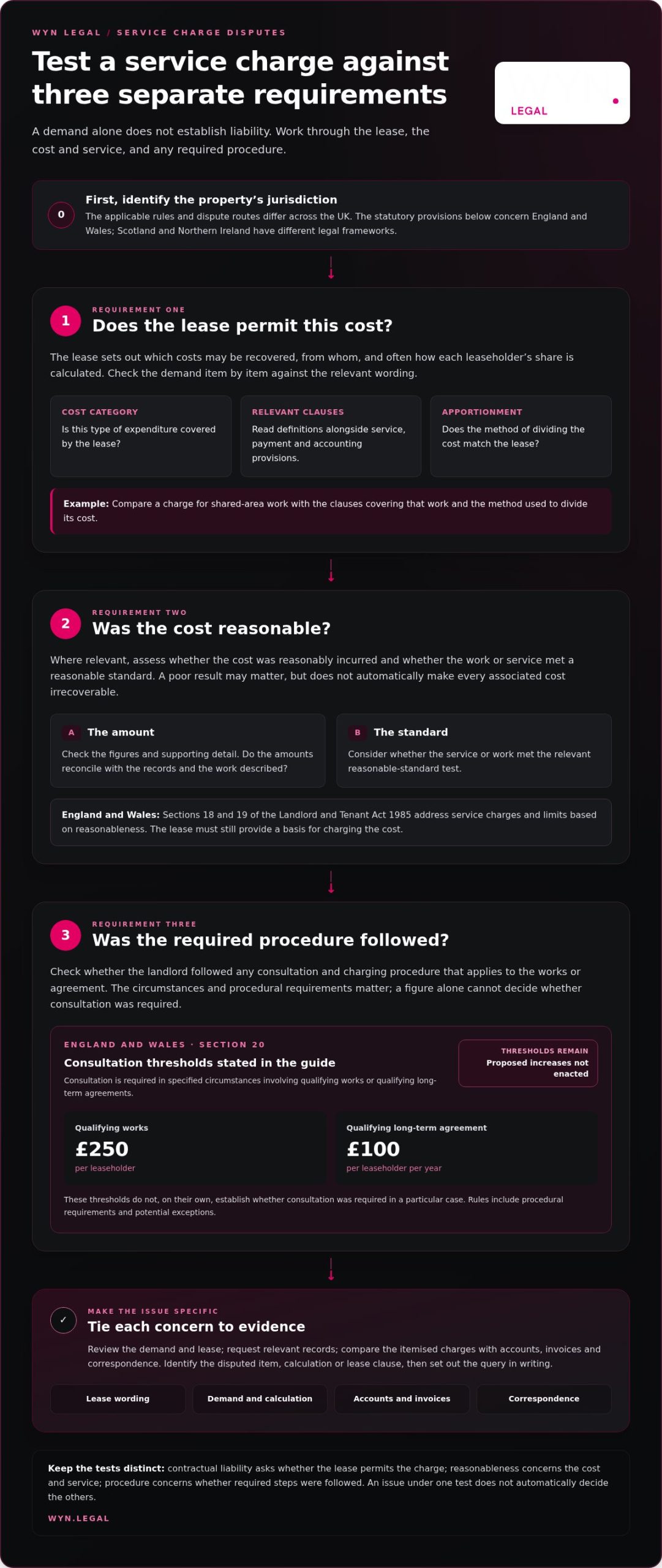
Test the demand against three separate requirements. First, does the lease make the leaseholder liable for this type of cost? Secondly, was the amount reasonably incurred and, where relevant, was the work or service of a reasonable standard? Thirdly, did the landlord follow any required consultation and charging procedure? A problem under one test does not automatically decide the others.
In England and Wales, sections 18 and 19 of the Landlord and Tenant Act 1985 define service charges and provide for limits based on reasonableness. This statutory test may affect whether costs are recoverable, but it does not replace the lease: the lease must first provide a basis for charging the cost. Scotland and Northern Ireland have different legal frameworks, so do not apply these provisions to a property there without checking the relevant jurisdiction.
Contractual liability asks whether the lease permits the charge; reasonableness asks whether the permitted cost and service meet the applicable legal test. These are distinct questions, and evidence supporting one does not necessarily answer the other.
What should the leaseholder check in the lease?
Read the service charge definition alongside the clauses identifying recoverable services and costs. Then examine how the lease apportions expenditure between flats or other parts of the building, when payment falls due, and whether any certification or accounting mechanism applies. For example, a clause referring to shared repairs should be read with the provisions governing which areas and leaseholders those repairs serve.
Do not treat a single phrase as decisive. Definitions, payment obligations, apportionment provisions and other relevant clauses may qualify or explain one another. Wording can affect liability, but its effect depends on the lease as a whole and the applicable law. Legal analysis of service charge disputes can help distinguish a genuine contractual issue from a disagreement about the bill alone.
When can consultation or reasonableness become an issue?
In England and Wales, section 20 of the 1985 Act requires consultation in specified circumstances involving qualifying works or qualifying long-term agreements. As at 2026, the thresholds remain £250 per leaseholder for qualifying works and £100 per leaseholder per year for a qualifying long-term agreement. Proposed increases to those thresholds have not been enacted. The rules include procedural requirements and potential exceptions, so the figures alone cannot establish whether consultation was required in a particular case.
Where consultation was required but not carried out, recoverable contributions may be limited to those thresholds unless the tribunal grants dispensation. This does not mean a charge is automatically eliminated: the facts, procedure and any dispensation must be considered. Confirm the current rules before relying on them, particularly where the property is outside England and Wales.
Reasonableness is a separate evidential question. Photographs, reports or correspondence showing poor workmanship may support a challenge to the standard of work, but do not, by themselves, prove that all expenditure is legally unrecoverable. Assess the lease, the work actually carried out, the cost and any applicable statutory requirements together.
Which route can resolve a service charge dispute?
Choose a route that matches the point in dispute. A missing breakdown may call for clarification; disagreement about particular costs may be addressed through review or negotiation; a defined legal issue that remains contested may require formal determination. Escalation is not an end in itself. The aim is to resolve the issue effectively while keeping a clear record of your position.
- Written clarification can address an unexplained item or calculation.
- Internal review gives the landlord or managing agent an opportunity to reconsider the demand or respond to specific concerns.
- Negotiation can help the parties agree which items are disputed and whether a practical resolution is available.
- Mediation uses an independent mediator to help the parties explore settlement. It is a possible option, not a compulsory step in every dispute.
- Formal determination asks the relevant court or tribunal to decide issues within its jurisdiction.
These routes can be sequential, but you do not have to pursue every informal option before considering formal action. The right strategy depends on the dispute, the evidence, the applicable procedure and any relevant deadlines.
When is an informal challenge or negotiation appropriate?
Use a focused written request where an explanation or targeted review may resolve the disagreement. Identify the disputed items, explain why you challenge them and specify what information or outcome you seek. Keep the demand, your correspondence and all replies together. This paper trail can narrow the issues and show what has and has not been resolved.
Pay close attention to timing. Sending a letter or entering negotiations does not, by itself, suspend or extend an applicable limitation period, tribunal deadline or payment obligation. Check relevant dates and obtain advice promptly if formal steps may be needed.
When might a tribunal determination be needed?
Formal determination may be appropriate when a concrete legal question remains unresolved, such as whether a sum is payable or whether a disputed cost falls within the tribunal’s powers. In England, the First-tier Tribunal (Property Chamber) generally deals with relevant residential service charge matters. Its jurisdiction is not unlimited: the issue, remedy sought and any related proceedings may affect the correct forum.
Do not assume the same route applies elsewhere in the UK. The applicable body, terminology, application procedure and available remedies depend on the property’s jurisdiction and should be verified. Costs consequences can also depend on the forum, the lease and the parties’ conduct; a tribunal application is not a guaranteed recovery mechanism.
Mediation may help resolve service charge disputes without a determination, particularly where the parties need to settle practical issues as well as legal ones. It does not decide the dispute unless the parties reach an agreement. A solicitor can assess the issue, jurisdiction and proportionate route before proceedings begin. WYN Legal advises on service charge dispute resolution, including contested matters requiring litigation or other resolution strategies.
What should you do before challenging a service charge?
Prepare before you object. A disciplined review helps you distinguish a disputed item from a general concern, identify documents that could resolve it and avoid steps that create unnecessary risk. Follow the sequence below and keep copies of everything you receive and send.
- Check the demand. Note the period covered, amount, due date and any explanation or supporting breakdown.
- Review the lease. Find the relevant service charge, apportionment, payment and certification clauses, and read them together.
- Request records. Identify the specific documents needed to understand the costs, calculations or work in question.
- Identify disputed items. Record each objection separately and connect it to the relevant lease wording or evidence.
- Respond in writing. Set out what you dispute, why, and what clarification or documents you are seeking. Keep your response measured and specific.
Rights to obtain a summary of accounts or inspect receipts and other supporting documents depend on the applicable law, type of charge and property’s jurisdiction. Verify the relevant statutory procedure before relying on a particular right or deadline. A request for records does not necessarily pause a payment date or other time limit.
Which documents and evidence should you preserve?
Keep the lease, service charge demands, budgets, accounts, invoices, consultation notices and related correspondence together. If the dispute concerns the condition of a shared area or the quality of completed work, preserve dated photographs, inspection notes and relevant contractor records. Save meeting minutes or notes recording what was discussed or agreed.
Build a concise chronology. For each disputed item, note the date, the point of concern and the document or image that supports it. Organised records can turn a broad objection into a clear, evidenced challenge.
How should you raise the dispute in writing?
Ask for a breakdown, the contractual basis for each identified item and the supporting documents needed to assess it. Explain precisely what remains unclear, such as how a cost was apportioned or what work an invoice covers. Separate disputed sums from items you do not dispute, and avoid allegations the available evidence cannot support. Retain proof of sending and any response.
Do not simply withhold payment because you disagree with a demand. The consequences depend on the lease, the amount and nature of the dispute, and the circumstances; non-payment may lead to further action. Equally, paying a demanded sum should not replace recording a properly framed objection. Obtain advice on the safest course if payment is due while the issue remains unresolved.
Where the lease, accounts or procedure are contested, seek legal advice on your service charge dispute before taking a step that may affect your position. WYN Legal advises and represents clients in service charge disputes, helping assess the evidence and appropriate route.
When should a solicitor advise on a service charge dispute?
Seek legal advice when the issue involves more than a straightforward request for clarification. Substantial disputed works, unclear lease wording, disagreement over how costs have been allocated between leaseholders, or several leaseholders contesting the same charge can complicate the analysis. Act promptly if proceedings have been threatened or started, since a response or application deadline may affect your options.
Early assessment does not commit you to litigation. It can clarify the strength of your grounds, what evidence is missing, which procedure applies and whether negotiation, mediation or formal determination is proportionate. The right route depends on the service charge issue and the property’s jurisdiction.
What can specialist advice help you assess?
A solicitor can examine the relevant lease provisions alongside the demand, accounts and supporting material, then assess whether the disputed items have a contractual basis and whether applicable legal tests or procedures may affect recovery. This can reveal gaps, such as unclear apportionment or a missing explanation, and distinguish points supported by evidence from assumptions that need testing.
Advice can also identify the forum, procedural steps and potential risks before a formal application is made. That assessment can shape a proportionate strategy, whether the next step is a focused request for information, a negotiated resolution or proceedings. It cannot guarantee a particular outcome.
What information should you prepare for a legal review?
Make the review efficient and precise. Gather the lease, recent demands, relevant accounts, invoices or other supporting documents, consultation notices and correspondence. Add a concise chronology of key events and mark the exact sums or items you dispute.
For each objection, state the reason and point to the document that supports it. For example, distinguish a concern about the lease basis from a concern about the amount, apportionment or quality of work. Include any response already received and note any impending deadline or hearing date. An organised file enables a focused assessment of merits, evidence gaps, procedure and available routes.
Where the lease, accounts or proceedings raise difficult questions, WYN Legal advises and represents clients in service charge disputes. Discuss a service charge dispute with WYN Legal to obtain advice tailored to your circumstances and consider a proportionate next step.
Take control of your next step
A service charge disagreement does not have to escalate before you act. A clear view of your position can help you decide whether to seek further information, pursue a resolution or prepare for a formal process. In service charge disputes, timing and strategy matter: avoid letting uncertainty dictate your response, particularly if a deadline or threatened proceedings are involved.
WYN Legal advises on service charge disputes and wider property litigation. The firm is authorised and regulated by the Solicitors Regulation Authority and can assess the issues and help you consider a proportionate way forward.
Explore your legal options with WYN Legal and take a considered step towards resolving the dispute. With a clear plan, you can approach what comes next with greater confidence.
Frequently Asked Questions
Can I challenge a service charge I consider unreasonable?
Yes, if you have grounds to dispute whether the charge is payable or reasonable under the lease and applicable law. In England and Wales, sections 18 and 19 of the Landlord and Tenant Act 1985 may allow relevant service charges to be challenged on reasonableness grounds. For example, a charge for repeated repairs may warrant scrutiny if the work was ineffective or the cost is not properly explained. The legal test and route depend on the property’s jurisdiction.
Can I refuse to pay a disputed service charge?
Do not assume that disputing a charge permits you to stop paying it. Arrears may prompt recovery action or other consequences under the lease, even where you have raised a genuine objection. The safest course depends on the terms, the disputed amount and the stage of the dispute. Get advice before withholding payment, and keep a written record of any payment made under protest or agreement about payment.
What evidence do I need for a service charge dispute?
Evidence should support the particular point you contest. For example, if you dispute a cleaning charge, records showing when the service was missed may be more useful than a general statement that the building was poorly maintained. For a calculation dispute, identify the figure or allocation you question and explain how it differs from the information available. Keep original documents and record when and how you received them.
Can a landlord charge for repairs without consulting leaseholders?
Sometimes. In England and Wales, section 20 consultation generally applies to qualifying works where a leaseholder’s contribution exceeds £250, subject to statutory rules and possible dispensation. As at 2026, the qualifying works threshold remains £250 per leaseholder. Whether consultation was required depends on the works, the contribution and the circumstances. Failure to consult may limit recovery unless dispensation is granted, but it does not automatically remove the entire charge.
Which tribunal deals with a service charge dispute?
In England, relevant residential service charge issues are generally determined by the First-tier Tribunal (Property Chamber). Its jurisdiction depends on the question being decided, so it may not be the right forum for every dispute or remedy. The procedure differs across the UK. For a property in Wales, Scotland or Northern Ireland, establish the applicable forum and rules before making an application, particularly if court proceedings are already under way.
Can I recover legal costs in a service charge dispute?
Not automatically. Whether legal costs can be recovered depends on the lease, the type of proceedings and any relevant court or tribunal order. In England and Wales, a lease clause may allow a landlord to seek legal costs through service charges, but statutory protections and the tribunal’s powers can be relevant. A successful challenge does not, by itself, guarantee reimbursement of your own legal expenses. Check the lease and costs position before proceeding.
Can tenants as well as leaseholders dispute a service charge?
It depends on who is legally liable for the charge and the rights that apply to the tenancy. A tenant who pays a separate charge under a tenancy agreement may have grounds to question it, but may not have the same statutory rights or application route as a leaseholder. Check the tenancy terms and identify whether the demand is made by the landlord or passed on through another arrangement. Advice can clarify who may challenge it.