

New build property dispute solicitor: choosing the right legal strategy
October 13, 2026
An inaccurate statement about a property is not, by itself, proof of a viable claim. Before instructing a property misrepresentation claim solicitor, establish what was said, whether you relied on it when buying, and whether that reliance caused financial loss.
A seller’s answer may appear plainly wrong, yet the legal and financial position depends on its wording, the evidence and the circumstances of the purchase. A structured assessment can identify the strengths, gaps and risks without assuming that litigation is the right outcome.
This checklist explains what to review before taking your next step: the statement you say was misleading, evidence of reliance, how to document loss, and the records a solicitor will need, including property forms, messages, survey reports and repair estimates. It also covers why limitation dates, potential court costs, time and the risk of an adverse outcome belong in your decision. WYN Legal advises on property misrepresentation claims, helping buyers assess the evidence and possible resolution routes before deciding how to proceed.
Key Takeaways
- Separate the statement you believe was misleading from evidence that it was false, influenced your decision and caused identifiable loss.
- Build a clear chronology and preserve original forms, correspondence, reports and other records showing what was said, by whom and when.
- A property misrepresentation claim solicitor will assess the strengths and gaps in your evidence, possible remedies and risks before advising on next steps.
- Record how the statement affected your purchase decision, including the transaction timeline and alternatives available at the time.
- Organise your documents, identify your losses and note your objectives before seeking advice. A prompt assessment can help protect your options.
Property misrepresentation claims: the first checks before instructing a solicitor
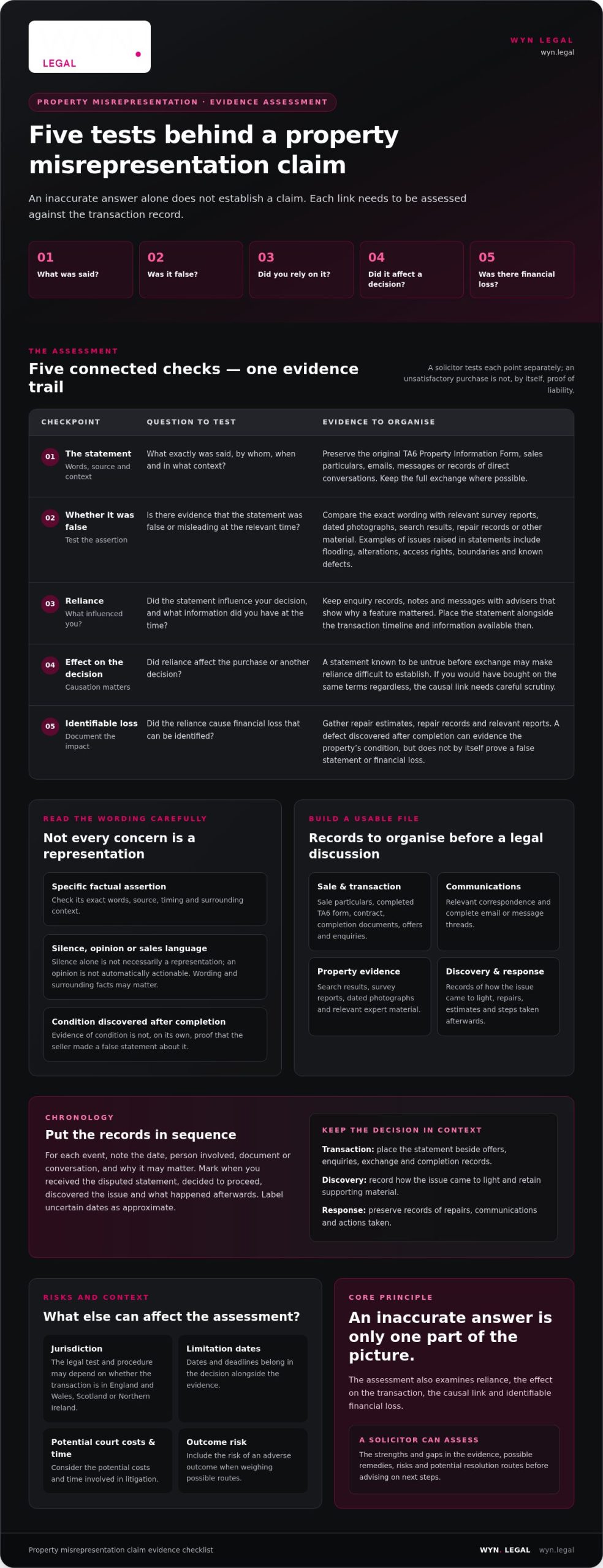
Start with the transaction, not the disappointment. A potential property misrepresentation claim involves a false or misleading statement that materially influenced a buyer’s decision to proceed. The initial assessment tests five connected points: what was said, whether it was false, whether the buyer relied on it, whether that reliance affected the purchase or another decision, and whether it caused identifiable financial loss.
Each point needs evidence. A property may have a serious defect without anyone making a relevant false statement. An inaccurate statement may also have had no effect on the buyer’s decision or caused no provable loss. A property misrepresentation claim solicitor examines these issues separately rather than treating an unsatisfactory purchase as proof of liability. The legal test and procedure may also depend on whether the property and transaction are in England and Wales, Scotland or Northern Ireland.
What kinds of property statements may matter?
Relevant statements can appear in answers on a TA6 Property Information Form, sales particulars, emails, messages or direct conversations with the seller. They may concern previous flooding, building alterations, access rights, boundary arrangements or known defects. The wording, speaker, timing and context all matter. These examples identify issues to investigate; they do not establish that a statement was false or that anyone is legally responsible.
Preserve the original record wherever possible. A completed form shows the precise question and answer; an email chain can establish when information was given and whether it was later corrected. Sales particulars may use broad promotional language, while a direct answer to a specific question may be more precise. The distinction is evidential, not automatic: read each communication in its full context.
Does an inaccurate statement automatically create a claim?
No. Inaccuracy is only one part of the assessment. The buyer must still show that the statement was material to the decision, that they relied on it and that the reliance caused the purchase or another decision and resulted in measurable loss. If the buyer knew the true position before exchange, for example, reliance may be difficult to establish. If they would have bought on the same terms regardless, the causal link also needs careful scrutiny.
Distinguish a specific factual assertion from silence, opinion, sales language and a condition discovered after completion. Silence alone is not necessarily a representation, although the surrounding facts and any applicable duties may matter. An opinion is not automatically actionable, but its wording and basis can be relevant. A defect discovered later is evidence of the property’s condition, not proof by itself that the seller made a false statement about it.
A property misrepresentation claim requires evidence of a false or misleading statement, reliance that affected the transaction, a causal link and identifiable loss. An inaccurate answer alone does not establish entitlement to a remedy. This concise Misrepresentation in common law overview offers background on the general concept, but the relevant law must be assessed in light of the transaction’s jurisdiction and facts.
Property misrepresentation claim checklist: evidence a solicitor will assess
Build an evidence file that lets a solicitor test your account against the transaction record. Preserve original documents and messages, note where each item came from, and avoid editing screenshots or adding conclusions to source material. A property misrepresentation claim solicitor needs to distinguish what the records establish from what remains an allegation.
Documents to organise before the first legal discussion
Collect records in a usable order. Include the sale particulars, completed TA6 Property Information Form, relevant correspondence, contract and completion documents. Add search results, survey reports, dated photographs, repair records and any relevant expert material. Keep complete email or message threads where possible, as the surrounding exchanges can affect how a statement is understood.
Then create a dated chronology. For each event, record the date, person involved, document or conversation, and why it may matter. Mark when you received the disputed statement, when you decided to proceed, when you discovered the issue and what you did afterwards. If a date is uncertain, label it as approximate rather than presenting a guess as fact.
- Statement: identify the exact words and source, such as a form answer, sales detail or message.
- Transaction: place the statement alongside offers, enquiries, exchange and completion records.
- Discovery: record how the issue came to light and retain the supporting report, photograph or correspondence.
- Response: keep records of repairs, communications and steps taken after discovery.
Evidence of reliance, causation and loss
Documents showing that a statement was false may not show that it influenced your decision. To evidence reliance, preserve records of your enquiries, notes, messages with advisers and communications explaining why a particular feature mattered to your purchase. The chronology can show whether the statement arrived before a key decision and what information was available at the time.
Next, document the alleged financial consequences without inflating or prematurely calculating them. Keep invoices and receipts for completed work, written repair assessments, relevant valuations and records of other expenditure said to arise from the issue. Separate amounts already paid from estimates for future work. A quotation or valuation is relevant to the assessment, but does not by itself prove that the amount is recoverable or was caused by the alleged statement.
Checklist: prove the statement with the source record, reliance with evidence of your decision, and loss with documents showing the financial consequence. The Misrepresentation Act 1967 forms part of the statutory framework relevant to misrepresentation claims, although the applicable law and available remedies depend on the facts and jurisdiction.
Keep the file factual and flag gaps rather than filling them with assumptions. A focused review of your property misrepresentation dispute can help organise the evidence, assess what it supports and identify issues that need further investigation.
Assessing a property misrepresentation claim: merits, remedies and risks
A sound assessment is comparative, not rhetorical. Treat each issue as a separate question: how clear and material was the statement, what supports or contradicts its alleged falsity, how strong is the evidence that it affected the purchase, and what loss can be connected to it? Strong evidence on one point does not automatically resolve the others.
Which issues can strengthen or weaken the assessment?
Start with the statement’s precision and source. A specific factual answer attributed to the seller may be easier to assess than vague promotional language, but its wording and context still matter. Identify who made or adopted it, whether it was communicated before the relevant decision, and whether another document qualifies or contradicts it.
Test your account against potentially adverse material. A survey, search result, later message or other independent check may show that the buyer knew, or had reason to investigate, the true position before proceeding. That may affect reliance or causation, though its significance depends on the full circumstances. Keep the seller’s knowledge analytically separate: whether a statement was false is not the same question as what the seller knew, and knowledge alone does not establish every element of a claim.
A property misrepresentation claim solicitor weighs these strengths and weaknesses together, including the quality of proof, likely disputes over key facts and the loss that can be evidenced. The legal characterisation of the alleged misrepresentation may affect liability and available remedies, so it should not be assumed from the allegation alone.
Which outcomes and routes may need consideration?
Damages and rescission are distinct remedies, not interchangeable labels. Damages seek financial compensation assessed under the applicable legal basis. Rescission seeks to unwind the transaction and restore the parties, so far as legally possible, to their pre-contract positions. It is fact-sensitive, may be affected by legal or practical obstacles, and is not an automatic consequence of proving a misrepresentation. Neither remedy should be treated as a guaranteed result.
The available route also calls for commercial judgement. Negotiation or settlement discussions may address the dispute without a trial, while litigation may be considered where the issues, evidence and objectives warrant it. Each route carries different demands. Litigation can involve expense, delay, procedural obligations and the risk that disputed evidence will not be accepted. Weigh the potential value of the claim against those realities.
- Merits: assess the statement, proof, reliance, causation and loss separately.
- Remedy: examine whether damages, rescission or another legally available outcome fits the facts.
- Proportionality: compare your objectives with the likely time, cost exposure and evidential uncertainty before committing to proceedings.
There is no single route for every property dispute. The broader discussion of property dispute legal options can help frame the possible paths. Advice on your circumstances should test the evidence, risks and objectives before you decide how to proceed.
Before instructing a property misrepresentation claim solicitor: your action checklist
Prepare before the first discussion. A concise, ordered account helps a property misrepresentation claim solicitor identify the central issues, missing evidence and decisions that may need to be made. It need not be a finished legal argument. Keep it accurate, preserve original records and mark uncertainty rather than filling gaps with assumptions.
Prepare a focused chronology and case summary
Set out the purchase, disputed statement, discovery and immediate consequences in date order. Name the people involved and note whether each detail comes from a document, your own direct recollection or someone else’s account. Record what you have already done to raise the issue, any response received and questions that remain unresolved.
- Preserve the evidence. Keep original forms, correspondence, photographs, reports and relevant digital records. Retain full message threads and avoid altering source files.
- Build the chronology. Note key dates, who communicated each statement, when you acted and when you discovered the issue. Identify approximate dates as approximate.
- Identify the alleged loss. List expenditure already incurred and anticipated costs separately, with the documents that support each item. Do not present estimates as established losses.
- Write down your questions. Record what you need advice on, including evidence gaps, practical objectives and steps already taken.
- Seek a prompt assessment. Timing may affect available options, so do not assume there is no urgency or rely on a general deadline without advice on the law applicable to your circumstances.
Questions to cover when discussing representation
Use the discussion to test the case, not simply repeat the allegation. Ask how the solicitor will assess whether the statement was false, whether you relied on it, whether it caused the transaction or loss, and which evidential gaps could matter. Ask what further documents or expert input may be relevant and how the assessment will distinguish strong evidence from disputed recollection.
Clarify the possible remedies and resolution routes, the likely stages of the matter, the principal risks and the decisions that may arise as it progresses. Ask which work is within the proposed scope, what could change that scope and what fee arrangement applies, including how further work or expenses will be addressed. Clear answers help you assess the commitment before deciding how to proceed.
For disputes involving a newly built property, the nature of the alleged statement and the parties involved may shape the issues. The discussion of new-build property dispute solicitors provides further context for that setting.
WYN Legal advises on property misrepresentation disputes through a focused assessment of evidence, loss, risk and possible resolution routes. Discuss your property misrepresentation claim with WYN Legal to make an informed decision about the next step, without assuming a particular outcome.
How WYN Legal approaches a property misrepresentation claim
A claim needs disciplined analysis before a strategy can be set. WYN Legal advises on property misrepresentation claims and dispute resolution, assessing the case against the evidence, relevant legal issues and the client’s objectives. The aim is to clarify the available options and material risks, not to assume that a claim will succeed or that litigation is inevitable.
From initial assessment to a considered strategy
An organised chronology and set of records give the legal review a clear starting point. WYN Legal examines the statement in its full context, who made it and when, what evidence bears on its accuracy, and how it may have affected the purchase decision. The assessment then considers causation and any loss said to have followed, keeping each issue distinct so that a gap in one part of the case is not obscured by strength elsewhere.
That review can identify where the available material supports your account, where it conflicts with it and what further evidence may be needed. A buyer’s recollection, a written answer and a later report may each carry different weight. The solicitor considers those differences alongside contrary documents, the transaction timeline and your priorities, rather than treating one record as conclusive in isolation.
Strategy must fit the facts. The applicable jurisdiction can affect the legal framework and procedure, while your aims may shape which outcomes are worth pursuing. Depending on the assessment, possible routes may include further investigation, negotiation, settlement discussions or litigation. These are options for case-specific advice, not fixed stages or promised outcomes. An informed recommendation should address the practical demands, uncertainties and risks attached to the routes under consideration.
Take the next step with WYN Legal
Bring the key documents, chronology and a short list of unresolved questions to the discussion. This allows a property misrepresentation claim solicitor to focus on the alleged statement, the evidence supporting or challenging it, reliance, causation, loss and your intended outcome. Where material is missing, identify the gap clearly. An accurate account of what is known and unknown is more useful than an unsupported conclusion.
WYN Legal is the trading name of Lawful Limited, which is authorised and regulated by the Solicitors Regulation Authority under SRA number 829708. Advice can help you understand the strengths, vulnerabilities and possible routes in your case, so you can decide how to proceed with a clearer view of the risks. It does not guarantee a particular result.
Bring your organised records and chronology for a focused discussion about your circumstances. Discuss your property misrepresentation claim with WYN Legal and take an informed next step.
Make your next move with a clear assessment
The next decision is not whether to commit to a court battle. It is whether the evidence and your objectives justify taking the matter further. A focused legal assessment can help turn uncertainty into a reasoned plan: what to investigate, which resolution routes may be proportionate and what risks should shape your decision.
WYN Legal advises on property misrepresentation claims, bringing a litigation and dispute-resolution perspective to that assessment. WYN Legal is the trading name of Lawful Limited, authorised and regulated by the Solicitors Regulation Authority, SRA number 829708. Advice can clarify your position, but no solicitor can responsibly promise a particular outcome.
Bring your chronology, key records and questions to a discussion with a property misrepresentation claim solicitor. The aim is to understand your options and decide your next step with greater confidence, not to assume that a claim must proceed.
Discuss your property misrepresentation claim with WYN Legal and take a considered step towards resolving the uncertainty.
Frequently Asked Questions
Can I claim against a property seller for misrepresentation?
A claim may be possible if a materially false statement influenced your purchase and caused loss, but an inaccurate answer alone is not enough. A property misrepresentation claim solicitor can assess whether the statement was actionable and how it affected your decision. For example, a response to a direct question may need to be considered alongside later correspondence that clarifies or contradicts it. The evidence and applicable law determine the position.
Does a seller have to disclose every problem with a property?
No general assumption that a seller must volunteer every defect is safe. The position depends on the transaction, the question asked and the law that applies. A failure to volunteer information is not automatically the same as making a false statement. Check the wording of the TA6 form or other enquiries, and retain the answer alongside any follow-up messages. Assess silence in context, not on its own as proof of a claim.
Can I make a property misrepresentation claim if the seller did not know the statement was false?
Potentially. A seller’s knowledge can affect how the alleged misrepresentation is analysed and which remedies may be available, but it does not replace the need to examine the statement and your reliance on it. For instance, a seller may have repeated information supplied by someone else. Preserve records showing the source of that information, if known, and the timing of communications. A solicitor can assess how those facts affect the legal case.
Can I claim against an estate agent or another party for property misrepresentation?
Possibly, depending on who made or adopted the statement, their role in the sale and the available evidence. The seller may not be the only person whose conduct needs examination, but an inaccurate marketing detail does not automatically establish liability. Keep the original particulars, dated versions if available, and communications with the agent. Note who supplied or confirmed the information, but do not assume responsibility until the documents and circumstances have been reviewed.
How long do I have to bring a property misrepresentation claim?
There is no single timeframe to rely on without advice about the claim and jurisdiction. The relevant dates, legal basis and when the issue came to light may affect how limitation is assessed. Record the dates of the purchase, the statement and discovery, then seek tailored advice promptly. Do not treat informal discussions with the seller as a reason to delay legal advice or assume they pause any applicable time limit.
Can I cancel a property purchase because of misrepresentation?
Rescission may be available in some circumstances, but it is not an automatic right to cancel a completed purchase. The type of misrepresentation, subsequent events and practical or legal obstacles can affect whether unwinding the transaction is possible. Damages may be another remedy, depending on the facts and legal basis. Before taking steps that could affect your position, obtain advice on the remedies realistically available and how each aligns with your objectives.
What evidence should I keep for a property misrepresentation claim?
Keep original sale documents and communications, including particulars, information forms, emails, messages, searches, surveys and photographs. Preserve full message threads and back up digital records without changing their contents. Make a separate note of when you first saw the relevant statement and when you became aware of the alleged problem. Invoices, valuations or repair assessments may help document financial consequences, but their relevance and weight require legal assessment.