

Business dispute solicitors: a strategic guide to resolving commercial conflicts
October 15, 2026
Partnership dispute solicitor: protect your position and business interests
October 17, 2026
An unresolved shareholder dispute can bring essential business decisions to a standstill. The first step to resolve a shareholder dispute isn’t necessarily to threaten court action. A rushed move can intensify the conflict and put further pressure on the company. If you’re facing disagreements over control, access to information or financial decisions, first clarify the rights involved and the commercial risks.
Start by establishing what happened, what the company’s governing documents say and what each party wants to achieve. This guide sets out a structured approach, from identifying the dispute and protecting business continuity to weighing negotiation, mediation and litigation. It explains how to compare those options against the evidence, shareholder rights and the company’s practical needs. When informal resolution is no longer enough, specialist legal advice can help you assess the position and decide on proportionate next steps.
Key Takeaways
- Distinguish shareholder disagreements from director disputes so you can identify the capacity in which each person is acting.
- Review the company’s governing documents and relevant decisions before drawing conclusions about voting, information or financial rights.
- To resolve a shareholder dispute, choose between negotiation, mediation or court action based on the evidence, commercial objectives and likely impact on the business.
- Protect the company’s position by preserving records, managing urgent risks and keeping communications factual and controlled.
- Specialist advice from WYN Legal can help assess the dispute and identify proportionate next steps when informal discussions are insufficient.
How to resolve a shareholder dispute: identify the conflict and its business impact
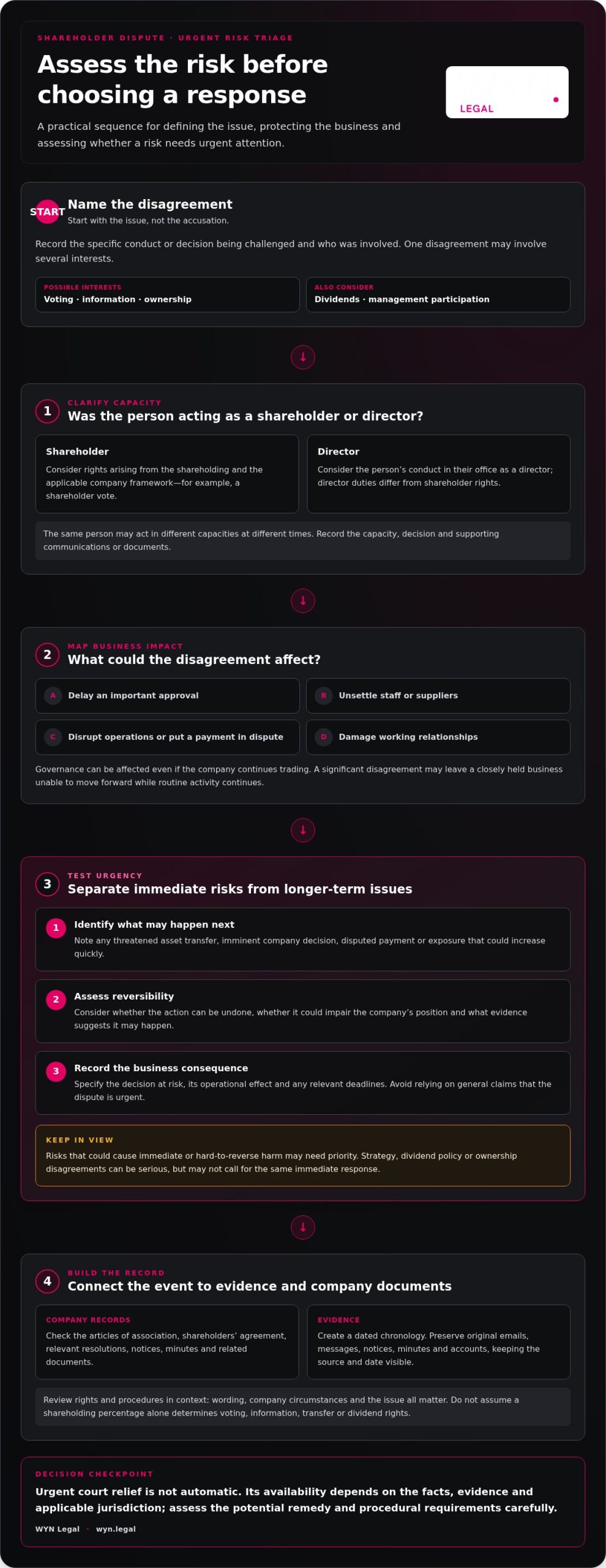
Start with the issue, not the accusation. A shareholder dispute concerns rights, control, company decisions or economic interests, such as voting, access to information, ownership, dividends or participation in management. One disagreement can involve several of these interests. Record the specific decision or conduct being challenged and who was involved.
Shareholders and directors have different legal capacities, even when the same person holds both roles. A complaint about a shareholder vote is not automatically a complaint about director conduct, and a director’s obligations differ from the rights they hold as a shareholder. Identifying the capacity in which someone acted helps define the issue and assess the available options.
A shareholder dispute can affect company governance without stopping the business from trading. It may delay an important approval, unsettle staff or suppliers, disrupt operations, put a payment in dispute or damage working relationships. In a closely held company, disagreement over a significant decision can leave the business unable to move forward, even while routine activity continues.
Which shareholder disputes need urgent attention?
Prioritise risks that could cause immediate or hard-to-reverse harm. Set them apart from longer-term disagreements about strategy, dividend policy or ownership. Those issues can be serious, but they may not require the same immediate response.
- Identify what may happen next. Note any threatened asset transfer, imminent company decision, disputed payment or exposure that could increase quickly.
- Assess reversibility. Consider whether the action can be undone, whether it could impair the company’s position and what evidence suggests it may happen.
- Record the business consequence. Specify the decision at risk, its operational effect and any relevant deadlines. Avoid relying on general claims that the dispute is urgent.
Urgent court relief is not automatic. Its availability depends on the facts, evidence and applicable jurisdiction. Assess the potential remedy and procedural requirements carefully before taking action.
Is the conflict about shareholder rights or director conduct?
Classify the complaint precisely. Is it about voting, information, participation, share ownership or the way the company is managed? A person may act as a shareholder in one event and as a director in another. Record the capacity in which each person acted, the decision involved and the documents or communications that support your account.
Director duties concern the office held, while shareholder rights arise from the person’s shareholding and the applicable company framework. Don’t assume every shareholder has identical rights or that an allegation of unfair treatment proves a legal breach. The concept of shareholder oppression can help explain how exclusion or conduct affecting minority shareholders may arise, but the facts and relevant law determine the legal analysis.
This initial assessment gives you a disciplined starting point to resolve a shareholder dispute: identify the conduct, its business impact, the capacity in which each person acted and any immediate risk. That clarity helps distinguish a strategic disagreement from a governance complaint, and an urgent threat from routine friction.
Assess shareholder rights, company documents and evidence before choosing a remedy
Build a documentary picture before settling on a position. The governing documents may define rights, procedures and resolution mechanisms relevant to the dispute. Their effect depends on their wording, the company’s circumstances and the issue in question. Don’t assume that a shareholder’s percentage holding alone determines their voting, information, transfer or dividend rights.
Start with the company’s constitutional documents, then check whether they have been amended, whether the relevant versions were properly adopted or signed, and whether later resolutions changed the position. A clause may seem decisive until you read it alongside another provision or the record of how a decision was made.
What company documents should a shareholder examine?
Begin with the articles of association and any shareholders’ agreement. Then review investment, funding and share-transfer documents that relate directly to the disagreement. Meeting notices, minutes and written resolutions can help establish what was proposed, who took part and whether the company followed the required procedure.
Keep the review focused on the issue. If the dispute concerns a proposed share transfer, trace the relevant transfer provisions, notices and communications. If it concerns a dividend, identify the provisions and resolutions relevant to the decision rather than assuming past payments created an ongoing entitlement. A dispute-resolution clause may also affect the options available. General material on Alternative Dispute Resolution (ADR) describes processes outside court, but it is a US government source, not guidance on UK procedure or the interpretation of a particular agreement.
How should a shareholder organise evidence?
Create a dated chronology linking each disputed act to the relevant decision, communication and financial record. Preserve original emails, messages, notices, minutes and accounts in an orderly format. Keep the source and date visible. Avoid editing originals or relying only on summaries when the original record is available.
- Link evidence to an issue. Record what happened, when it happened, who was involved and which right, decision or procedure it may concern.
- Separate fact from inference. Distinguish firsthand records from assumptions, disputed recollections and information that needs independent verification.
- Capture business consequences. Note any operational disruption, payment in dispute or unresolved decision, with supporting records where available.
This approach makes gaps visible. If minutes refer to a resolution but the notice or supporting papers are missing, record that gap rather than filling it with an assumption. A clear chronology can also show whether separate incidents form a pattern or whether the disagreement centres on a single decision.
Once the documents and evidence are organised, you can assess whether a proposed response fits the rights involved and the company’s commercial priorities. WYN Legal’s shareholder dispute advice can help test that analysis and identify proportionate next steps before positions harden.
Compare negotiation, mediation and court routes to resolve a shareholder dispute
No single route suits every conflict. The appropriate route depends on the rights involved, the evidence, the urgency and the commercial objective. Compare each option against five practical factors: who controls the outcome, whether the working relationship can be preserved, how confidential the process is, how an agreement becomes enforceable and how much disruption the company may face.
Negotiation lets the parties control proposals and timing, but neither side can compel agreement. Mediation adds an independent facilitator while leaving the decision with the parties. Court proceedings put the decision in a judge’s hands and may provide formal remedies, but can affect management time, relationships and business continuity. Confidentiality is not guaranteed in every route. It depends on the process, agreements and applicable rules. Record any settlement in terms that clearly address the parties’ obligations and how they will take effect.
When might negotiation or mediation be suitable?
These routes may be worth considering when the parties can exchange relevant information, make proposals and take part in structured discussion without leaving urgent risks unmanaged. Possible terms might include revised governance arrangements, an agreed approach to a decision or an exit, if those outcomes fit the dispute. A mediator facilitates discussion but does not impose a settlement. Any agreement remains voluntary.
Negotiation can be a proportionate first step when the issue is clearly defined and the parties have authority to agree practical terms. Mediation may help when direct discussions have stalled or need more structure. Neither route is suitable simply because it is less confrontational. A refusal to share essential information, a need for urgent protection or a fundamental disagreement about the facts may limit its usefulness. The American Arbitration Association’s shareholder dispute information describes mediation and arbitration within its own framework. It is a US resource, not guidance on UK procedure.
When might a court application become relevant?
Court action may need to be considered when rights require formal determination, urgent protection is sought or the parties cannot resolve the issue by agreement. In England and Wales, section 994 of the Companies Act 2006 provides a route for a member to petition on grounds of unfair prejudice to members’ interests. A derivative claim is different: a member brings it on behalf of the company concerning an alleged wrong to the company, and statutory requirements, including permission from the court, apply.
An injunction may be relevant when the evidence and legal test support urgent protective relief. A winding-up petition is a serious step with potentially far-reaching consequences for the company, not a routine way to apply pressure. The facts, remedy sought and applicable UK jurisdiction matter. Take specialist shareholder dispute advice before issuing a claim or taking a step that may be difficult to reverse.
To resolve a shareholder dispute, match the route to the outcome sought: a workable agreement, protection of a specific right or a formal decision. A measured assessment helps avoid choosing negotiation when urgent intervention is needed, or litigation when a viable commercial agreement remains possible.
Take practical steps to manage the dispute and protect the company’s position
Keep your response disciplined. A shareholder dispute can create pressure to act quickly, but an unauthorised payment, premature announcement or decision made outside proper governance procedures may deepen the conflict. Before taking a step that could be difficult to reverse, establish who has authority, what the governing documents require and whether legal advice is needed.
Use this sequence to protect the company while you assess how to resolve a shareholder dispute:
- Stabilise urgent risks. Identify imminent decisions, financial exposure or threatened actions. Take proportionate steps within your authority to manage immediate business risks, without assuming unilateral action is justified.
- Preserve relevant records. Retain emails, messages, meeting papers, financial records and notices. Keep originals intact and limit access appropriately.
- Review the governing documents. Check the relevant provisions, amendments, approvals and procedures before proposing action or making statements about rights.
- Define the objective. Separate the outcome sought for the company from the outcome sought by each shareholder. Consider what would keep operations stable while addressing the dispute.
- Assess the route forward. Decide whether structured discussions remain viable or whether urgency, evidence or the nature of the issue calls for formal advice or action.
How can shareholders prepare for a resolution discussion?
Prepare a concise chronology and issue list. Mark each point as agreed, disputed or dependent on missing information, then state the outcome sought for each issue and identify the records that support it. This keeps discussions focused and helps show what information could enable progress.
Frame proposals around both the company’s continuity and the concern raised. For example, if the disagreement concerns approval of a major commitment, a proposal might address how that decision will be handled while the parties work through the wider issue. Don’t present a preferred solution as agreed or make commitments on behalf of the company without authority.
What should happen when an informal resolution attempt fails?
A failed discussion is a reason to reassess, not to escalate automatically. Review whether the evidence has changed, whether an immediate risk has emerged, whether the documents set out a process and whether the commercial objective remains achievable. Identify any applicable pre-action or procedural requirements before issuing a claim. These depend on the proposed action and jurisdiction, so verify the current position.
Specialist legal advice can help test the evidence, identify potential remedies and weigh the consequences of continuing, settling or ending the dispute. WYN Legal advises on shareholder disputes and business conflicts. Advice focused on the facts can help shape proportionate next steps and account for the company’s commercial priorities.
For a strategic assessment of a shareholder dispute, WYN Legal’s shareholder dispute advice can help you consider the company’s position before taking a consequential step.
Get strategic advice to resolve a shareholder dispute with WYN Legal
Make your next move with a clear view of the legal and commercial position. Specialist advice can assess the rights in issue, the available evidence, the company’s priorities and proportionate routes forward. This helps distinguish what may be addressed through structured discussions from issues that could require formal action, without assuming a particular outcome.
WYN Legal is a specialist litigation and dispute-resolution firm advising on shareholder disputes and other business conflicts. The firm can analyse the position against your objectives, identify material risks and help you understand the practical implications of possible next steps. The focus is a strategy suited to the dispute, not a promised result.
What to prepare before seeking legal advice
A focused briefing makes it easier to identify the central issues. Gather the articles of association, any shareholders’ agreement, relevant resolutions and documents directly connected to the dispute. Include key communications and records that support or qualify your account, rather than sending an unstructured archive without context.
Prepare a concise chronology and state what needs attention now. Identify any imminent decision, threatened action or immediate business consequence, then explain the commercial outcome you want to pursue, such as restoring workable governance, maintaining continuity or exploring an exit. Separate your preferred outcome from what you consider essential.
- Documents: List what you have, what appears relevant and any important missing records.
- Events: Note the dates, decisions and communications that led to the dispute.
- Priorities: Identify urgent risks, business needs and realistic resolution objectives.
How WYN Legal can help assess the route forward
WYN Legal can consider how the governing documents, evidence and parties’ conduct relate to the dispute, then assess potential responses against the company’s commercial priorities. This may include evaluating whether further negotiation is viable, what risks formal proceedings could involve, and which procedural or jurisdictional issues need attention. The assessment considers both the legal position and the practical impact on the business.
Be candid about the points that weaken your position as well as those that support it. A clear assessment of uncertainty can sharpen the strategy, help avoid steps that damage the company’s position and inform decisions about whether to continue, revise or conclude discussions. No route guarantees a particular outcome. Informed advice helps you choose and carry out the next step with greater control.
For tailored advice on your shareholder dispute, contact WYN Legal to discuss the facts, commercial objectives and steps available to protect the company’s position.
Set a clear course for what happens next
Your next decision should create direction, not simply intensify the disagreement. Set a practical objective for the next stage: preserve the company’s ability to operate, secure a decision that cannot be deferred or establish whether a negotiated outcome remains realistic. A clear objective gives each further step a commercial purpose.
To resolve a shareholder dispute, focus on the outcome you need and the risks you must manage, rather than reacting to every development in isolation. WYN Legal advises on shareholder disputes as part of its business dispute work. Its advice can help you assess the position and choose proportionate next steps, without promising a particular result. Lawful Limited, WYN Legal’s trading name, is authorised and regulated by the Solicitors Regulation Authority, SRA number 829708.
Take a considered next step. Discuss your shareholder dispute with WYN Legal to consider a strategy that reflects your rights, commercial priorities and the company’s position.
Frequently Asked Questions
Can the majority shareholders force a minority shareholder to sell?
Not simply because they hold a majority. A compulsory sale needs a valid basis, such as an applicable provision in the articles of association or shareholders’ agreement, or a statutory mechanism that fits the circumstances. Check any transfer or drag-along clause for its trigger, notice requirements, pricing method and procedure. A majority vote alone doesn’t establish that those conditions are met, so obtain advice before agreeing to a transfer or challenging one.
How long does it take to resolve a shareholder dispute?
There’s no fixed timetable. A dispute may move more quickly if the issues are narrow, records are available and the parties can negotiate. Contested facts, complex company arrangements or court proceedings can extend the process. Urgent applications may address an immediate issue but don’t necessarily determine the whole dispute. To resolve a shareholder dispute efficiently, set clear objectives, respond to deadlines and avoid delaying decisions while evidence or positions remain unclear.
Can a shareholder also be removed as a director?
Yes. A person may be removed from the director’s office while retaining their shares. Under section 168 of the Companies Act 2006, a company may remove a director by ordinary resolution, subject to procedural requirements including special notice. Removal as a director does not itself cancel the person’s shareholding. Review the company’s articles, the circumstances and any relevant agreements before action, because the roles and resulting rights are distinct.
What happens to a company while shareholders are in dispute?
The company can continue trading, but the dispute may affect decisions, oversight and commercial confidence. For example, disagreement over approval authority could delay a contract, while competing instructions may unsettle employees or suppliers. Directors must continue to manage the company’s affairs through proper governance, rather than treating a shareholder’s position as automatic authority to act for the company. Keep routine operations and essential approvals clearly documented, and identify decisions that genuinely require shareholder agreement.
Does every shareholder dispute require a court claim?
No. Some disputes can be addressed through direct discussions, mediation or another process allowed by the relevant agreement. A court claim may be considered when agreement is not achievable, a legal right needs determination or a remedy is sought. Before escalating, identify the specific outcome needed and whether a contractual dispute-resolution clause or procedural requirement applies. Informal discussions should not cause a party to overlook a deadline or urgent risk.
Can a shareholder dispute force a company to close?
Not automatically. Disagreement alone does not close a company, although serious deadlock, financial pressure or disruption to essential decisions can threaten its viability. In some circumstances, a shareholder may seek a winding-up order, but this is a significant legal step that depends on the facts and applicable law. Closure is not the only possible response to a dispute. Assess the effect on the company’s ability to operate before taking action that could put its future at risk.