

Property Misrepresentation Claim Solicitor: A Buyer’s Checklist for 2026
October 14, 2026
Going straight to court can spend commercial leverage before a dispute is properly understood. Businesses searching for business dispute solicitors need more than a route to proceedings: they need a strategy shaped around the strength of their position, the evidence available and the interests they must protect.
A conflict can drain management time, disrupt operations and put valuable commercial relationships under pressure. Delay may also weaken your ability to act decisively. The right first step is not always the most formal one. Negotiation, mediation and litigation each have distinct advantages and risks, and the best route depends on the dispute and your objectives.
This guide explains how to compare those options, assess urgency and preserve evidence that may determine your position. It also covers the decisions that shape an effective legal strategy, from protecting commercial interests to considering the impact on the wider business. WYN Legal advises on complex contractual, debt, ownership and intellectual property disputes, connecting dispute-resolution and litigation strategy with your commercial objectives. The aim is to help you make informed decisions before the conflict dictates them.
Key Takeaways
- Assess how the dispute affects cash flow, operations and commercial relationships before deciding how to respond.
- Build your position by identifying the legal issue, organising evidence and testing the other party’s position against relevant documents and obligations.
- Compare negotiation, mediation, arbitration and litigation by considering control, formality, confidentiality and enforceability.
- Prepare for advice by defining your objectives, gathering records, identifying deadlines and setting out key questions for business dispute solicitors London.
- WYN Legal advises businesses on complex contractual, debt, ownership, intellectual property and other commercial disputes, aligning legal strategy with commercial objectives.
Business disputes: understand the commercial stakes before acting
A business dispute concerns commercial rights, obligations or interests. It may involve an unpaid invoice, the meaning of a contract, ownership of a company or the use of intellectual property. The legal issue is only part of the assessment. A claim can also tie up cash, interrupt delivery, unsettle staff or suppliers, strain a valuable relationship and consume senior management time.
Assess the amount in dispute alongside its wider commercial impact. A modest unpaid debt may create a serious cash-flow problem if it prevents the business from paying its own suppliers. A disagreement over a continuing contract may be worth resolving pragmatically if both parties remain essential to operations. By contrast, ongoing conduct that threatens business continuity, records or assets may need urgent attention. A dispute is commercially significant when its effect on the business’s ability to operate, protect value or meet its objectives outweighs the figure attached to the claim.
A legal disagreement does not automatically mean the business should litigate. The facts may support several routes, such as negotiating a change to the arrangement, agreeing a payment plan or bringing a formal claim. Options include negotiation, mediation, arbitration and court proceedings, as outlined in Dispute Resolution Methods. The right response depends on what needs protecting and what outcome the business can usefully achieve, not simply on who feels most aggrieved.
What makes a business dispute commercially significant?
Start by establishing three things: what must be preserved, how urgent the matter is and what the business wants to achieve. Keep relevant contracts, emails, invoices, meeting notes and performance records in their original form. Note key dates and any continuing conduct that could worsen the position. Identify operational dependencies, immediate cash-flow exposure and deadlines that may affect your options. Then state the desired result plainly, for example, securing payment, preserving a supplier relationship or preventing further use of protected material.
This assessment gives business dispute solicitors London a clearer basis for evaluating the legal position alongside commercial realities. Specialist advice can help test assumptions early, before a forceful response or delay narrows the available choices.
Which business disputes may require specialist advice?
Different disputes call for different analysis. Contract disputes turn on the agreed terms, performance and the alleged breach. Debt disputes concern sums claimed as due and any response to the demand. Ownership disputes may involve partners or shareholders, their rights and the governance of the business. Intellectual property disputes concern rights in material such as branding or creative work. Professional negligence claims involve allegations that professional services fell below the required standard and caused loss.
These categories can overlap. A disagreement about a shareholder’s conduct may also raise contractual issues, while a supplier dispute may involve both performance and an unpaid balance. The legal assessment depends on the facts, documents and applicable law. Do not treat a label as a conclusion. Establish what happened, what was agreed, what evidence supports each position and which commercial objective takes priority.
How a solicitor builds a business dispute strategy
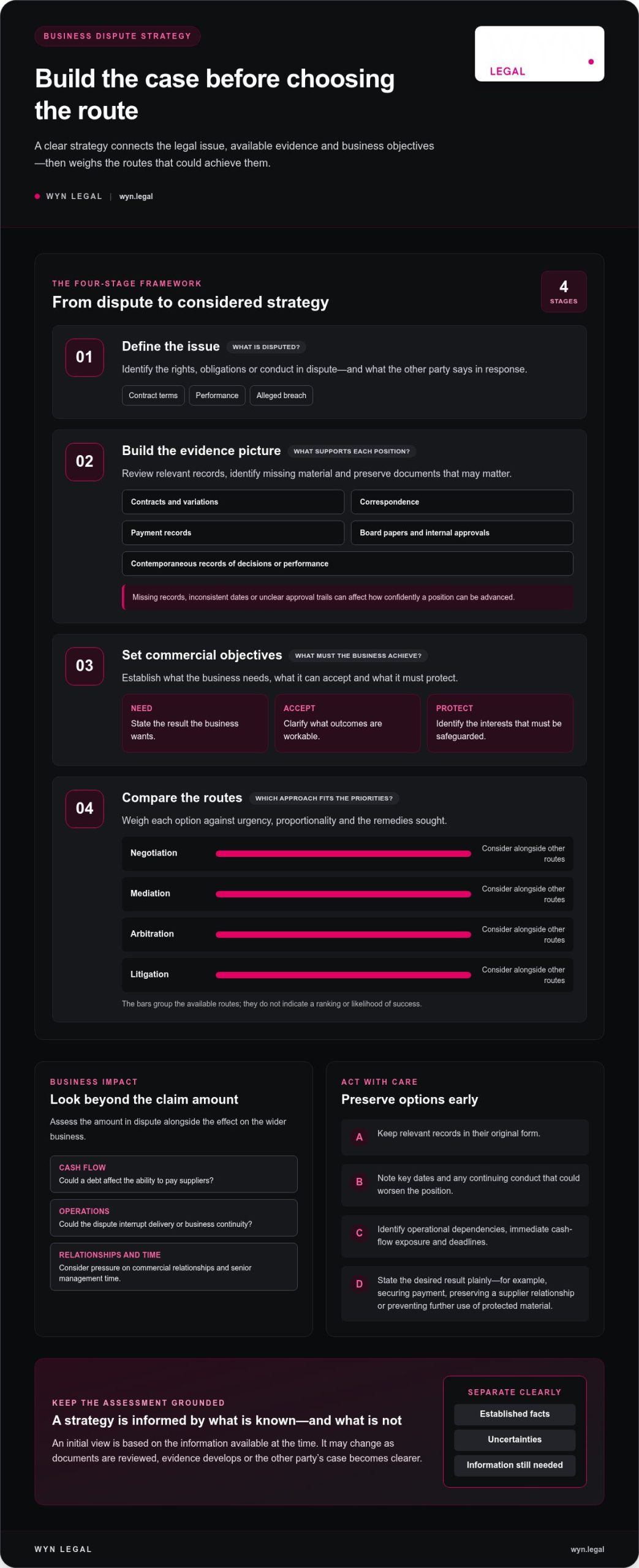
A strong strategy starts with disciplined assessment, not an assumption that the dispute must end in court. A solicitor identifies the legal issue, tests the available evidence, establishes what the business needs to achieve and compares routes against those priorities. Each stage informs the next. If a key contract term is unclear or a deadline is approaching, that may change both the immediate response and the options worth pursuing.
The process is structured:
- Define the issue. Identify the rights, obligations or conduct in dispute, and what the other party says in response.
- Build the evidence picture. Review relevant documents, identify missing material and preserve records that may be important.
- Set commercial objectives. Establish what the business needs, what it can accept and what it must protect.
- Compare routes. Weigh negotiation, mediation, arbitration or litigation against urgency, proportionality and the remedies sought.
This process does not predict success. An initial assessment is based on the information available at the time. The view may change as documents are reviewed, evidence develops or the other party’s case becomes clearer. A solicitor should distinguish what is established, what remains uncertain and what further information could affect the analysis.
How are the legal position and evidence assessed?
Assessment is document-led. Depending on the dispute, relevant material may include contracts and variations, correspondence, payment records, board papers, internal approvals and contemporaneous records of decisions or performance. The solicitor compares those materials with each party’s account and the obligations that may apply. Missing records, inconsistent dates or unclear approval trails can affect how confidently a position can be advanced. Preserve relevant material and do not alter or delete records.
The applicable legal duties, evidential rules and available remedies depend on the claim and its circumstances. Urgency matters too. Ongoing conduct, threatened disruption or an approaching deadline may require a different sequence of action from a dispute that can be examined without immediate operational pressure. For court-based commercial claims, the UK Commercial Court Procedures provide official information about that court’s role. Whether that forum is appropriate requires case-specific analysis.
How do commercial objectives shape the strategy?
The business may seek recovery of money, continued performance, protection of assets or information, operational continuity, or an orderly exit from a relationship. These aims can point in different directions. A settlement may need to address future performance, timing, confidentiality or a clear separation, as well as any financial remedy. Set out priorities and acceptable compromises before choosing a route.
Business objectives set the target, evidence tests the position, and the chosen route must serve both. This keeps legal steps tied to practical decisions rather than momentum alone. For tailored advice on contractual, debt, ownership or other commercial disputes, WYN Legal’s business dispute advice connects legal assessment with commercial priorities.
Negotiation, mediation or litigation: compare business dispute routes
There is no universally superior route. The right choice depends on the dispute, the evidence, the urgency and whether the parties are willing to engage. Before committing to a course of action, compare practical control, formality, privacy and what makes an outcome binding. Early resolution may preserve options, but it does not remove the need to assess risk or prepare the case.
| Route | Formality and control | Confidentiality and enforceability |
|---|---|---|
| Negotiation | Usually the least formal. Parties control discussions and whether to settle. | Privacy depends on how discussions are conducted and any applicable protections. A concluded settlement may be binding, depending on its terms and formation. |
| Mediation | A neutral mediator facilitates discussion but does not decide the dispute. Parties retain control over whether to agree. | Confidentiality depends on the applicable arrangements and law. A settlement can be recorded in binding terms; mediation itself does not impose a decision. |
| Arbitration | A private, more formal process in which an appointed tribunal decides the dispute, subject to the applicable agreement and rules. | Proceedings are generally private, though confidentiality is not absolute. An award is generally binding, with enforcement and challenge governed by the relevant legal framework. |
| Court litigation | A formal process in which a court determines issues and remedies under procedural rules. Parties do not control the outcome. | Hearings and judgments are generally public, subject to exceptions. A court judgment may be enforced through applicable procedures. |
These are broad distinctions, not guarantees about how a particular dispute will proceed. The contract, any agreed rules, the nature of the claim and the relevant law can affect the process, privacy and enforceability. Commercial-law analysis also informs how rights and remedies are assessed; academic context is available through LSE Law School’s legal studies.
When may negotiation or mediation be appropriate?
Negotiation can suit a dispute where the parties can communicate directly and retain a shared commercial interest, such as completing outstanding work or agreeing revised payment terms. Mediation introduces a neutral facilitator to help test proposals and explore settlement. Before either process, define the desired outcome, acceptable terms, authority to agree and points that cannot be conceded. Neither route guarantees agreement, and neither suits every conflict.
When might arbitration or court proceedings be considered?
Check the contract first. Its dispute-resolution terms may provide for arbitration or affect whether that route is available. Arbitration may offer a private decision-making process, while litigation asks a court to determine the issues and any remedies within its jurisdiction. The procedural, confidentiality and enforcement consequences require case-specific legal review. Business dispute solicitors London can assess these factors alongside the evidence and commercial priorities before a route is selected.
Choosing business dispute solicitors: assess fit, preparation and value
The first discussion should turn a difficult situation into a clear set of decisions. Prepare enough to explain the dispute, its impact on the business and what you need to achieve. You do not need to resolve every legal question in advance. A focused brief helps a solicitor identify the issues, highlight immediate priorities and explain what further information may be needed. When choosing business dispute solicitors London, assess the quality of the strategic advice as well as the firm’s relevant dispute experience.
Use this four-step checklist before an initial discussion:
- Define your objective. Decide whether the priority is recovery, continued performance, protection of an asset, business continuity or a structured exit. Note what outcome would be acceptable and what would not.
- Organise the records. Prepare a short chronology, key agreements, relevant correspondence and a concise summary of the issue. Identify important documents that may be missing.
- Identify deadlines and pressure points. Flag dates in contracts or correspondence, ongoing conduct and decisions that cannot wait, such as a threatened interruption to supply.
- Prepare key questions. Ask what the immediate legal issues are, what information is needed, what routes may be available and what decisions require your authority.
What should a business prepare before an initial discussion?
Keep the material focused. A clear timeline should show what happened, when, who was involved and which documents support each event. Separate established facts from assumptions or disputed accounts. Explain how the issue affects operations and identify any urgent decision. Avoid sending unnecessary confidential or personal information before appropriate safeguards and a secure method for sharing documents have been agreed.
How should a business assess legal support?
Relevant experience matters, particularly where the dispute involves contractual obligations, debt, ownership or intellectual property. Clarity matters too: the solicitor should explain the legal issues, uncertainties and commercial trade-offs in terms you can use to make decisions. Assess whether the advice reflects your business priorities and gives you a practical understanding of next steps, not just procedural detail.
Discuss the proposed scope, likely stages, material risks and fee arrangements directly with your solicitor. Establish what work is covered, what could change the plan and how decisions will be communicated as the matter develops. Clear expectations support informed decisions, but do not remove uncertainty. No solicitor can guarantee a particular result, and an early view may change as evidence or the other party’s position becomes clearer.
WYN Legal advises businesses on complex commercial disputes, connecting legal strategy with commercial objectives. Discuss your business dispute with WYN Legal to consider the issues, preparation and decisions that matter to your case.
WYN Legal business dispute solicitors: move from assessment to action
Take action in a clear sequence: assess the commercial stakes, establish the evidence, select a proportionate route and act on the priorities that matter to the business. Each decision should be grounded in the facts and the outcome sought, not an assumption that every conflict belongs in court. WYN Legal provides specialist support on dispute-resolution and litigation matters, with advice connected to commercial objectives.
WYN Legal advises businesses on contractual, debt, ownership, intellectual property and other commercial disputes. This includes disagreements over contractual obligations, unpaid debts, shareholder or partnership interests, and intellectual property rights. The firm also advises on professional negligence disputes. The legal route and available remedies depend on the circumstances; advice assesses the position without promising a particular result.
What business dispute matters does WYN Legal handle?
Commercial disputes can cross categories. A shareholder disagreement may raise questions about ownership and contractual obligations; a supplier conflict may involve both performance and an unpaid balance. WYN Legal handles contract, debt recovery, partnership, shareholder and intellectual property disputes, as well as other business matters. Where a dispute has a cross-border dimension, the firm’s international desks may be relevant, including in the UAE, Saudi Arabia, Bahrain, Malta, Spain and the United States.
What happens after a business makes contact?
A focused discussion helps clarify what has happened, what the business needs to protect, how urgent the matter is and what material is available. A short chronology, key agreements and relevant correspondence can help establish the central issues. The advice is tailored to the dispute and its commercial context, rather than imposed through a fixed process or timeline. It should identify practical priorities and the decisions that may need to follow.
Clarity first. Then a proportionate plan. Lawful Limited, trading as WYN Legal, is authorised and regulated by the Solicitors Regulation Authority, SRA number 829708. The advice focuses on the dispute, its evidence and the business’s objectives. A solicitor can assess risks and options, but cannot guarantee a particular outcome.
Bring the issue into focus by setting out the key events, the effect on your business and the result you need to pursue. Speak to WYN Legal about your dispute and consider the next strategic step.
Set the next move on your terms
A dispute should not set your business agenda by default. Identify who within the business has authority to act, preserve the capacity needed to run operations, and agree how decisions will be reviewed as the matter develops. Aligning the people who need to make or approve those decisions can prevent mixed messages and help keep the business focused.
Engaging business dispute solicitors London is most useful when advice sharpens decisions, not simply adds process. Take forward a clear account of what must be protected and what outcome would let the business move ahead. A considered strategy gives you a basis to act firmly while retaining control over the choices that remain yours.
WYN Legal advises on complex commercial disputes and can help assess the next step in light of your objectives and circumstances. Speak to WYN Legal about your business dispute. Make the decision deliberately and put your business in a stronger position to move forward.
Frequently Asked Questions
How long does a business dispute usually take?
There is no standard timetable. Duration depends on the issues, the volume of evidence, the parties’ willingness to engage and the route pursued. Negotiations may conclude sooner than formal proceedings, but that is not assured. Timing can also depend on how quickly records are gathered, whether specialist evidence is needed and the steps required by the chosen process. A solicitor can explain likely stages after reviewing the circumstances and documents.
Can a business claim its legal costs from the other party?
Possibly, but cost recovery depends on the dispute, forum, applicable rules and any agreement between the parties. Even if costs may be recoverable, an award may not cover all the legal fees incurred, and recovery is not guaranteed. Before taking a significant step, consider both the potential costs exposure and the commercial value of the result sought. Ask your solicitor to explain the relevant risks for your particular matter.
What happens if the other party ignores a formal letter about a business dispute?
Silence does not resolve the dispute or prove that your claim is correct. Keep a copy of the letter and evidence of when and how it was sent, then review its requests and any stated dates. The appropriate next step depends on the letter’s contents, supporting evidence and the other party’s conduct. A solicitor can advise whether to follow up, propose another route or take further action, and explain the risks involved.
Can a director be personally responsible for a company’s business dispute?
A company dispute does not automatically make a director personally liable. The position depends on the legal basis of the claim, the facts, any personal commitments and the director’s own conduct. For example, a personal guarantee may raise separate questions from a contract signed only by the company. If a director is named personally or accused of individual wrongdoing, obtain advice promptly so their position can be assessed separately.
How are business dispute solicitors’ fees determined?
Fees depend on the work required, the complexity of the issues, the evidence, urgency and route under consideration. Ask for a clear explanation of the proposed scope, billing arrangements and likely stages, including how additional work or a change in circumstances may be handled. Do not assume another dispute’s fee structure will apply to yours. Before substantial work begins, make sure you understand the terms and how fees will be communicated.
When should a business instruct a dispute solicitor?
Seek advice when a dispute threatens commercial interests, involves important sums or obligations, creates urgent risk or cannot be contained through ordinary discussions. Early input can help identify what should be preserved and which decisions need attention before positions harden. It does not commit the business to court proceedings. Businesses considering business dispute solicitors London should focus on advice that addresses the specific legal issue and the commercial decision at stake.