

Partnership dispute solicitor: protect your position and business interests
October 17, 2026
An unpaid invoice is a commercial risk, not simply an accounting delay. When cash flow is under pressure, a business debt recovery solicitor can help you assess the evidence, choose a proportionate next step and protect your position before the dispute escalates.
Caution is sensible. A demand unsupported by clear contracts, invoices or records of the work supplied may invite challenge, while formal proceedings can add expense without securing payment. Start by establishing what is owed, what the debtor disputes and whether further action makes commercial sense.
This guide sets out a practical recovery process for 2026, from reviewing the agreement and payment history to communicating with the debtor and considering court action or enforcement. You’ll learn what evidence to assemble, how the debtor’s response affects your options and when a solicitor can advise or represent your business in a debt recovery dispute.
The legal route depends on the debtor and the jurisdiction that applies. Make each move deliberately, using the available evidence and your wider commercial priorities to guide the decision.
Key Takeaways
- Assess the agreement, invoice and payment history before escalating, and identify precisely what the debtor disputes.
- Organise your evidence and clarify the contractual basis of the claim before sending a formal demand.
- A business debt recovery solicitor can assess the debtor’s response and help shape a proportionate pre-action strategy.
- Consider negotiation, court proceedings and enforcement as separate decisions, weighing each against your commercial priorities.
- Where recovery turns on a contractual or wider commercial dispute, consider how those legal issues affect your next move.
Business debt recovery: assess the debt before escalating
An unpaid invoice can put immediate pressure on cash flow, but escalating before checking the claim may weaken your commercial position. Commercial debt recovery means pursuing money owed to a business under a commercial arrangement, such as a contract for goods supplied or services completed. The aim is not simply to send demands. First establish what is due, on what basis and which response best protects the business.
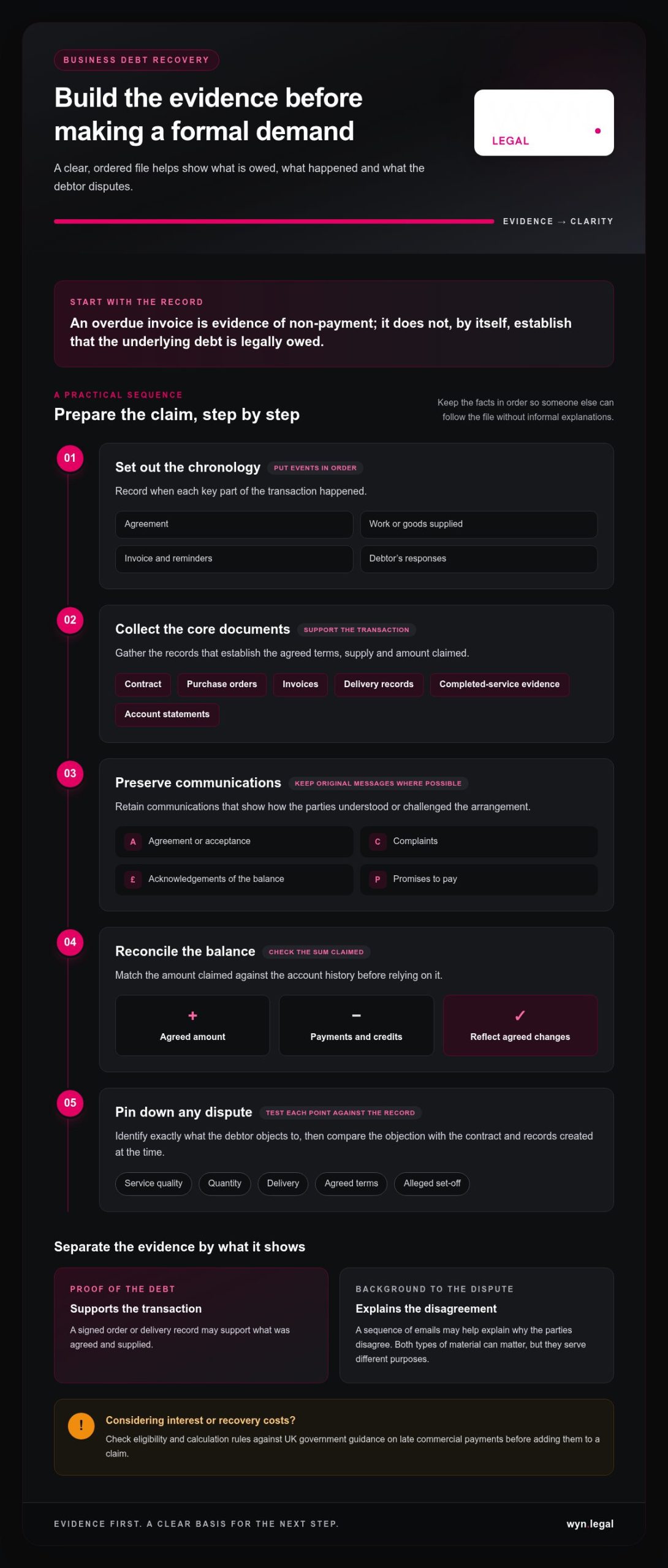
An overdue invoice is evidence of non-payment; it does not, by itself, establish that the underlying debt is legally owed. The invoice may not reflect the agreed terms, a later variation, a credit or a genuine complaint about performance. A business debt recovery solicitor can help assess these issues before the dispute moves into a more formal process.
Debt recovery is part of a broader set of debt collection practices, but the rules and procedures for a particular claim depend on its circumstances and jurisdiction. For the wider commercial context, WYN Legal’s guide, Business dispute solicitors: a strategic guide to resolving commercial conflicts, considers how disputes can affect a business’s position.
Is the debt due, identifiable and properly documented?
Build the claim from the transaction outwards. Compare the contract or purchase order with the invoice and the delivery record or evidence that services were completed. Check that the creditor and debtor are correctly identified, and that the sum claimed reflects the account after payments, credits and agreed variations.
Record the due date, payment terms and relevant account history. Preserve correspondence in which the debtor acknowledges the balance, asks for time to pay or explains why payment is being withheld. This can help distinguish a delayed payment from a disputed obligation or disagreement about the amount.
Use this initial checklist:
- Amount claimed, including any recorded payments or credits
- Due date and applicable payment terms
- Correct legal identity of the debtor
- Contract, purchase order and evidence of supply or completed services
- Correspondence, payment history and any stated objections
What could affect the commercial case for recovery?
Consider the debtor’s response alongside the documents. A specific allegation of defective goods, incomplete work or an agreed set-off may need investigation. Silence or a promise to pay may point to a different next step. Also consider whether there are credible signs the debtor can pay. Even a sound claim can require time and procedural work without producing a commercially useful result.
Weigh the likely recovery prospects against the debt’s value, the available evidence, any counterclaim and the resources needed to pursue the matter. Recovery is not an automatic march towards proceedings. A solicitor advising on debt recovery disputes can help assess the legal basis and commercial priorities, particularly when the unpaid invoice forms part of a wider contractual conflict.
Build a strong business debt recovery claim before making a formal demand
Preparation helps make a demand clear, credible and supported by the transaction record. Before writing to the debtor, organise the facts in sequence and distinguish evidence of the sum owed from material explaining how the disagreement developed. Let the factual basis, contractual terms and debtor’s objections shape the strategy, rather than assumptions about what happened.
A clear chronology can expose gaps, contradictions and unanswered questions before they weaken your position. It also helps a business debt recovery solicitor identify what is established, what needs clarification and which issues the demand should address.
How should a business organise evidence for debt recovery?
Build a file that someone else can follow without relying on informal explanations. Start with the agreement and the work or goods supplied, then add the invoice, due date, reminders and material responses. Preserve original emails and messages where possible, and keep account records so payments and credits can be reconciled against the amount claimed.
- Set out the chronology. Record the dates of the agreement, performance, invoice, reminders and debtor responses.
- Collect the core documents. Include the contract, purchase orders, invoices, delivery records, evidence of completed services and relevant account statements.
- Preserve communications. Keep messages that show agreement, acceptance, complaints, acknowledgements or promises to pay.
- Reconcile the balance. Match the amount claimed against payments, credits and any agreed changes to the work or terms.
Keep proof of the debt distinct from background material. A signed order or delivery record may support the transaction; a sequence of emails may explain why the parties disagree. Both can matter, but they serve different purposes. If you are considering interest or recovery costs, check eligibility and calculation rules against UK government guidance on late commercial payments before adding them to a claim.
How should you assess a disputed invoice or counterclaim?
Define the objection precisely. Is it about service quality, quantity, delivery, the agreed terms or an alleged set-off? Then test each point against the contract and records created at the time. For example, compare a complaint about incomplete work with completion records and the parties’ messages, rather than dismissing or accepting it without scrutiny.
Separate agreed facts from contested ones, identify missing documents and note what the business needs to address. A dispute about performance may change both the amount pursued and the appropriate next step. Where the debt sits within a wider contractual conflict, consider the broader issues covered in Business dispute solicitors: a strategic guide to resolving commercial conflicts.
A solicitor can review the chronology, documents and objections to help assess the claim before a formal demand is sent. Where the dispute turns on contractual rights as well as an unpaid balance, WYN Legal advises businesses on debt recovery disputes and related commercial conflicts.
How a business debt recovery solicitor manages the pre-action stage
Before escalating a claim, a solicitor assesses the evidence, the debtor’s response and the pre-action requirements that apply to the dispute. This stage is not a formality. A letter that overstates the case or sets an unsuitable response deadline can undermine a measured approach, particularly where the debt is disputed or the debtor is an individual rather than a company.
The applicable procedure depends on the debtor and jurisdiction. In England and Wales, the Pre-Action Protocol for Debt Claims applies to claims against individuals, including sole traders; debts between limited companies are generally subject to the Practice Direction on Pre-Action Conduct. From 1 October 2026, where the creditor has an electronic contact method for a debtor covered by the Protocol, the Letter of Claim is expected to be sent by that method as well as by post. A business debt recovery solicitor can identify the requirements that apply before setting a response date.
What should a formal letter of claim achieve?
A formal letter should state the sum claimed, explain its factual and contractual basis, and make clear what response is sought. It should give the debtor enough information to understand and address the claim, with relevant documents identified or provided as required by the applicable rules. Be precise. For example, describe incomplete work as the debtor’s allegation unless it has been established, rather than presenting it as an accepted fact.
Response deadlines are not interchangeable. The Debt Claims Protocol provides a 30-day response period for an individual or sole trader, while company-to-company claims follow different pre-action expectations. The correct period depends on the applicable procedure and circumstances, so check it rather than copying a deadline from an earlier demand. The Commercial Law League of America provides an industry perspective on commercial collections, but it is not a source of UK procedural rules.
When can negotiation or a payment proposal make commercial sense?
A refusal to pay does not always mean proceedings are the best immediate step. A proposal to pay by instalments, or a focused exchange about a specific contractual issue, may be proportionate if it fits the evidence and the business’s cash-flow needs. Assess the proposal against the debtor’s stated position, the timing of payments and the risk that delay could affect practical recovery.
Record any agreed terms clearly. A proposal is not automatically a binding settlement, and correspondence should distinguish a discussion from a concluded agreement. Statutory interest and fixed compensation may be available for qualifying late commercial debts, but eligibility and calculation depend on current legal requirements and the circumstances. Do not add them as automatic sums without checking.
Pre-action engagement should preserve the claim while allowing you to assess whether a credible resolution is possible. WYN Legal advises and represents businesses in debt recovery disputes, helping align the next step with the evidence, debtor response and wider commercial position. Explore WYN Legal’s debt recovery dispute advice.
Choose the next debt recovery route when payment is refused or disputed
A refusal to pay does not make court proceedings automatic. Choose the next step by weighing the evidence, the debtor’s explanation, the likely practical value of recovery and the demands each route places on the business. Negotiation, issuing a claim and enforcing a judgment are separate decisions. A business debt recovery solicitor can help assess these options in light of the dispute and applicable court procedure.
Use this comparison to frame the decision, not as a substitute for checking the rules that apply in the relevant UK jurisdiction.
| Route | When it may fit | Key considerations and risks |
|---|---|---|
| Continue negotiation | The debtor engages, proposes payment or raises an issue that may be resolved through clarification or compromise. | Assess the proposal against the evidence, timing and cash-flow priorities. Delay may be unhelpful if discussions stall or the debtor’s position worsens. |
| Issue court proceedings | The claim has a supportable legal basis, the debtor will not pay and informal resolution has not produced an acceptable outcome. | Consider the defence, procedural requirements, likely time and expense, and whether pursuing the claim remains proportionate. A disputed claim may require more than a simple online filing. |
| Enforce a judgment | A judgment has been obtained but the debtor has not paid as required. | Enforcement is a separate process. The available method depends on the jurisdiction, eligibility, debtor’s circumstances and assets; further steps may not secure payment. |
When might court proceedings be considered?
Proceedings may be appropriate where the documents support the claim and the debtor has not raised a substantive defence that changes the assessment. Weigh that basis against the business’s objectives, procedural obligations and tolerance for delay and further expense. In England and Wales, the small claims track generally covers claims valued at £10,000 or less, including interest added by the issue date. That allocation threshold is not a universal rule across the UK.
Money Claim Online is a route for eligible claims, not a solution for every debt or jurisdiction. Claim type, value, complexity and the debtor’s response can affect whether it is suitable. Confirm the applicable procedure before issuing.
What can happen after a judgment or agreed payment plan?
A County Court Judgment establishes the court’s decision on the claim; it does not establish that the debtor has funds available or will pay voluntarily. If payment is not made, enforcement may be considered as a separate step, subject to the relevant rules and the debtor’s circumstances. An instalment proposal may offer a practical resolution, but it does not guarantee full recovery.
For a considered assessment of a disputed debt, its evidence and proportionate next steps, instruct WYN Legal on your business debt recovery dispute.
Instruct a business debt recovery solicitor with a clear commercial strategy
Legal advice is most useful when it starts with a defined objective. A business debt recovery solicitor can assess the legal basis of the claim, the evidence, the debtor’s response and the proportionate options available. That assessment should inform a strategy, not commit the business to proceedings before the commercial case has been weighed.
Prepare a concise, organised file before seeking advice. This allows the solicitor to focus on issues that could change the next step, such as a disputed contractual term, an unexplained account balance or a proposed counterclaim. It also helps clarify what the business needs from the process beyond pursuing an invoice.
What information should you prepare before seeking legal advice?
Bring the relevant documents and a short summary of the position. A clear account of the facts helps a solicitor distinguish established points from matters that need investigation and assess the options against your business priorities.
- The contract, purchase orders, invoices and relevant delivery or completion records
- Account statements showing the amount claimed, payments received and any disputed items
- A dated chronology of key events, including payment due dates and material debtor correspondence
- The debtor’s explanation, any counterclaim or set-off, and what the business has said in response
- Your preferred commercial outcome, including whether settlement or staged payment is acceptable
Be candid about weaknesses as well as strengths. If records conflict, work was varied or a complaint was raised before the invoice fell due, identify that early. The legal analysis can then account for the full picture instead of relying on an incomplete version of events.
How does recovery strategy change when the debt is part of a wider dispute?
A debt may be connected to unfinished work, alleged defects, a contractual variation or a separate claim between the same parties. Treating the invoice in isolation could overlook a counterclaim, affect ongoing commercial dealings or lead to steps that do not address the real dispute. Account for those connections while keeping the recovery objective clear.
WYN Legal advises and represents businesses in debt recovery disputes, as well as contractual and wider commercial conflicts. Its business disputes experience is relevant where the question is not only whether an invoice remains unpaid, but how the underlying agreement and the parties’ competing positions affect the available route. The guide Business dispute solicitors: a strategic guide to resolving commercial conflicts explores that wider context.
Decide what matters most before choosing a route: recovery of the full balance, a negotiated settlement, staged payment or a resolution that protects a continuing business relationship. No legal step can guarantee payment or a particular outcome, but a structured assessment can help ensure the decision reflects the evidence and your priorities. Discuss your business debt recovery dispute with WYN Legal to consider a strategy grounded in both.
Put your next recovery decision on a stronger footing
The next move should serve the business, not simply prolong the dispute. Before committing to a course of action, set out the outcome you need, the commercial limits you cannot ignore and the information that could change your decision. A focused discussion with a business debt recovery solicitor can help turn those priorities into a considered strategy, without assuming that court action is inevitable or that any route guarantees payment.
WYN Legal advises on debt recovery disputes and wider commercial conflicts, bringing the contractual context into the assessment where it matters. The firm is authorised and regulated by the Solicitors Regulation Authority. The right decision depends on your circumstances, evidence and business objectives.
Take the next step with a clear account of the dispute and the result your business is seeking. Discuss your business debt recovery options with WYN Legal and move forward with a strategy that protects your commercial position.
Frequently Asked Questions
How can a business debt recovery solicitor help recover an unpaid invoice?
A business debt recovery solicitor can assess the agreement, supporting records and debtor’s explanation, then advise whether correspondence, negotiation or proceedings is proportionate. For example, if a customer accepts the invoice but disputes one line item, the solicitor can help distinguish the agreed balance from the contested amount. They can also explain procedural risks and possible next steps. No solicitor can guarantee payment; the debtor’s means and any defence may affect recovery.
Can a solicitor recover a disputed business debt?
Yes, a disputed debt may still be pursued, but the nature of the disagreement matters. A complaint about late delivery, for instance, raises different issues from a denial that any contract was made. The solicitor can examine the relevant terms, the alleged breach and records from both sides to assess the claim and response. A payment demand alone doesn’t establish that the disputed sum is legally due.
What happens if a business ignores a letter of claim?
Ignoring a letter doesn’t automatically decide the dispute or guarantee that a court claim will succeed. Before deciding whether to issue proceedings, the creditor should review the stated response date, applicable pre-action requirements and any reply received. If the debtor later provides a defence or supporting documents, those may affect the case. Court procedure and timing depend on the claim and jurisdiction, so don’t assume one timetable applies across the UK.
Can a business claim interest on an overdue commercial debt?
Possibly, but statutory interest or compensation isn’t automatic for every unpaid invoice. Eligibility can depend on the commercial arrangement, the parties and relevant contract terms. Before including an additional sum in a demand, identify its legal basis and check the current calculation rules. A mistaken figure can create an avoidable point of dispute, so itemise the principal debt and any proposed interest or compensation clearly.
Does a County Court Judgment guarantee that a business will recover its debt?
No. A County Court Judgment is a decision on liability, not proof that the debtor has funds to pay. If payment doesn’t follow, further enforcement may be considered, but the options and prospects depend on the debtor’s circumstances and the applicable rules. Before taking another step, consider whether there is a practical basis for enforcement and whether additional time and expense are commercially justified.
How long does business debt recovery take in the UK?
There is no single timetable. A debtor who accepts the balance and pays after correspondence presents a different situation from one who disputes liability and defends a claim. The time needed can also depend on how promptly each party responds, the evidence required and the relevant court process. Treat any estimate as case-specific, and verify current procedural information before relying on a projected date.
Is it worth instructing a solicitor for a small business debt?
It can be, but the amount alone shouldn’t determine the decision. Consider the quality of the records, whether the debtor has a credible defence, the importance of resolving the matter to the business and the effort further action may require. For example, a smaller balance tied to an ongoing contractual relationship may need a different approach from an isolated invoice. A solicitor can explain the options and risks, but recovery is never assured.