

WYN Legal secures possession order within 14 days in decisive rent arrears win for high profile Doctor
October 8, 2026
Interim Schedule of Dilapidations: What Tenants and Landlords Need to Know
October 11, 2026
Court is a route, not a default. The right property dispute legal options depend on what has happened, the evidence available and the outcome you need, not simply on how quickly conflict escalates. A disagreement over a boundary, shared ownership, building work, a tenancy or a contract may call for a different response. Some apparent disputes also begin with a misunderstanding that can be clarified before anyone makes a legal claim.
It is understandable to worry that taking action could make matters worse, expose you to costs or leave you unsure about evidence, deadlines and the right forum. But formal proceedings are not the only option. Negotiation and alternative dispute resolution may offer a proportionate route, while litigation may be necessary when other approaches cannot resolve the issue or protect your position.
This guide explains common property disputes and compares negotiation, mediation and formal proceedings. It also covers practical first steps, including preserving relevant documents and identifying time-sensitive issues. WYN Legal advises on property disputes, assessing the evidence, risks and available routes so you can make an informed decision about what to do next.
Key Takeaways
- Identify whether the conflict concerns property rights, obligations, occupation, use or condition before choosing how to respond.
- Set out your objectives and organise the relevant documents first. Then consider communication and alternative dispute resolution where appropriate. This is a guide, not a rule.
- Compare property dispute legal options by control, formality, confidentiality and who makes the final decision.
- Preserve original records and create a dated chronology to organise evidence and identify issues that may need prompt attention.
- Specialist advice can help assess the evidence, risks and proportionate route, including whether formal proceedings should form part of the strategy.
Property dispute legal options: identify the issue before choosing a route
A property conflict can disrupt occupation, investment, business operations and relationships, while leaving you uncertain about your rights and next steps. Not every disagreement is already a legal claim. A misunderstanding about an agreement or boundary may need clarification, while conduct affecting someone’s legal rights may call for a more formal response.
A property dispute is a disagreement about rights, obligations, occupation, use or condition of property. Identify the legal and practical issue before choosing a remedy. The wrong route can consume time and resources without addressing what you need to resolve.
Which kinds of property dispute may require legal action?
Identifying the type of dispute helps establish which documents, parties and potential remedies matter. Common examples include:
- Ownership: disagreements between co-owners about their respective interests, decisions or plans for jointly owned property.
- Boundaries and use: conflicts about the extent of land, access or how neighbouring property is being used.
- Leases: disputes between landlords and tenants, or between leaseholders and others, involving obligations, occupation, alterations or property management.
- Building work: disagreements about the performance, scope or consequences of work carried out at a property.
- Possession: disputes concerning who is entitled to occupy or recover possession of a property.
- Contracts: disputes about property-related agreements, including what was promised, whether it was fulfilled and what loss may have followed.
These categories can overlap. A disagreement between co-owners is not the same as a landlord and tenant dispute, even if both concern who may occupy a home. A leaseholder’s issue may involve contractual obligations as well as the condition or management of a building. The legal framework and appropriate forum depend on the facts and jurisdiction, so a familiar label does not determine the answer. The broad distinction between consensual processes, such as negotiation and mediation, and adjudicative processes is also outlined in Dispute Resolution Methods.
What should you establish before deciding what to do?
Build a clear account before taking a position. Identify who is involved, what interest each party has in the property, what conduct is disputed and what practical outcome you seek. An owner seeking agreement about shared decisions may need a different resolution from a landlord addressing occupation or a party seeking compensation for uncompleted work.
Next, separate immediate risks from issues that can be addressed through planned correspondence. A threat to access, occupation or the condition of the property may need prompt assessment. A disagreement about terms or responsibility may allow time to organise records and set out concerns carefully. Do not let urgency obscure the underlying issue, but do not ignore a risk that could worsen while you wait.
The property dispute legal options available depend on the issue, supporting documents and intended outcome. This article provides general information, not advice on your particular circumstances. Specialist advice can help assess these factors and identify a proportionate way forward.
How property dispute resolution works: negotiation, mediation and formal action
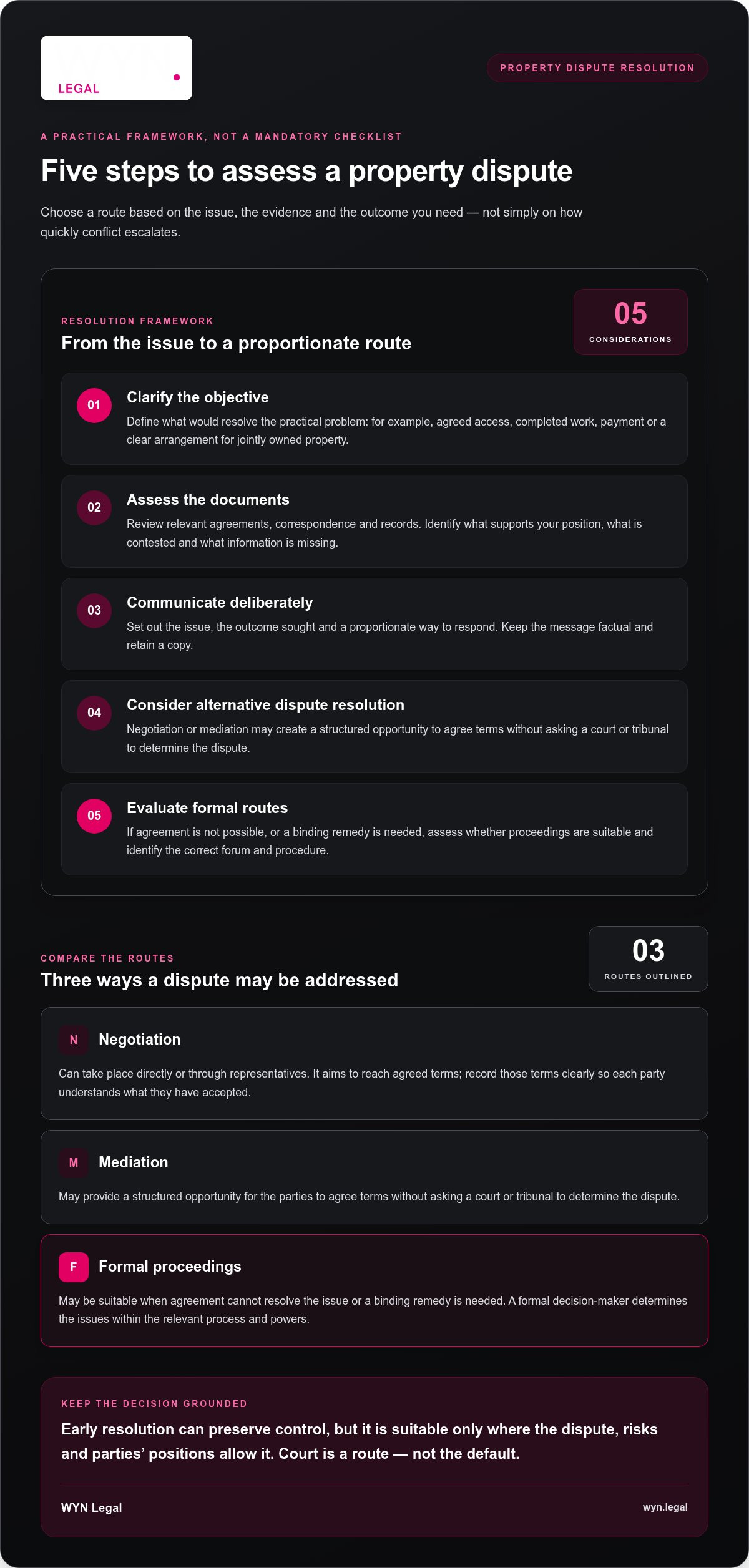
There is no single route for every property conflict. A measured process can help preserve your options without treating court action as the automatic first move. Use this sequence as a framework, not a mandatory checklist. Urgency, the parties’ positions and the remedy required may make another approach more appropriate.
- Clarify the objective. Decide what would resolve the practical problem, such as agreed access, completion of work, payment or a clear arrangement for managing jointly owned property.
- Assess the documents. Review relevant agreements, correspondence and records against the issue in dispute. Identify what supports your position, what remains contested and what information is missing.
- Communicate deliberately. Set out the issue, the outcome sought and a proportionate way to respond. Keep the message factual and retain a copy.
- Consider alternative dispute resolution. Negotiation or mediation may provide a structured opportunity to agree terms without asking a court or tribunal to determine the dispute.
- Evaluate formal routes. If agreement is not possible, or a binding remedy is needed, assess whether proceedings are suitable and identify the correct forum and procedure.
Early resolution can preserve control, but it is suitable only where the dispute, risks and parties’ positions allow it. Negotiation may produce a tailored agreement. A formal decision-maker determines the issues within the relevant process and powers.
When can negotiation or mediation help resolve a property dispute?
Negotiation can take place directly or through representatives. It aims to reach agreed terms, which should be recorded clearly so each party understands what they have accepted. Some genuine settlement discussions may be conducted on a without-prejudice basis, but the label alone does not determine whether that protection applies. Context and purpose matter, so take advice before relying on it.
Mediation introduces an independent facilitator to help the parties explore the issues and possible terms. The mediator does not impose a decision. Mediation may suit a dispute where the parties want to retain influence over the outcome, but it depends on meaningful participation and an ability to negotiate. Urgent protection, entrenched positions or approaching legal deadlines may affect whether it is appropriate. Discussions do not automatically suspend applicable deadlines.
When might a formal claim or tribunal route be considered?
Court proceedings may be considered when attempts to agree have failed, a party will not engage, or the remedy sought requires a formal determination. Some property issues may instead fall within a specialist tribunal’s jurisdiction, depending on the type of dispute. Check the correct forum, procedure, available remedies and any relevant time limits against the facts and jurisdiction before taking action.
Formal action carries procedural and cost risks, so assess the evidence and intended outcome before committing to a route. WYN Legal can review these property dispute resolution options with you, including whether negotiation remains viable or proceedings are proportionate.
Compare property dispute legal options: settlement, mediation or litigation
Each route allocates control, risk and decision-making differently. In a settlement, the parties choose whether to agree and what terms to accept. Mediation adds a facilitator, but the parties still decide whether to settle. Litigation places the dispute before a court, where the outcome is determined through a formal process. The useful question is not simply which route seems easiest, but which can address the issue and deliver the remedy you need.
What are the practical differences between settlement, mediation and court?
Use this comparison as a starting point. Timing and confidentiality depend on the facts, applicable rules and any terms agreed between the parties, so neither should be assumed.
| Factor | Settlement | Mediation | Litigation |
|---|---|---|---|
| Control | The parties decide whether to agree and shape the terms. | The parties retain control of any agreement; the mediator facilitates discussion. | The parties present their positions, but the court determines the issues it is asked to decide. |
| Formality | Can be discussed directly or through representatives; agreed terms should be recorded clearly. | A structured process with a facilitator, rather than a hearing. | A formal process governed by applicable procedural rules. |
| Timing | Depends on engagement and the scope of negotiations. | Depends on availability, preparation and whether agreement is possible. | Depends on the procedure, issues and progress of the case. |
| Confidentiality | May depend on the context and terms of discussions or agreement. | Is subject to the applicable mediation arrangements and rules. | Is governed by court rules and the circumstances of the case. |
| Decision-maker | The parties must reach agreement. | The parties decide whether to settle; the mediator does not impose an outcome. | A judge or other authorised decision-maker determines the matter. |
Settlement is not a decision imposed on either side. It depends on agreement by the relevant parties, and its terms should address the actual dispute rather than leave key obligations uncertain. Mediation can help parties test possible terms with a neutral facilitator, but it cannot compel agreement.
Litigation is different. It involves formal steps, evidence and procedural requirements, with the court determining the matters before it. It may be necessary where agreement has failed or a formal determination is required. It is not automatically the next step simply because a solicitor is instructed. A solicitor can assess the position, advise on correspondence or settlement, and consider alternatives before recommending proceedings.
How should you weigh risk, evidence and the outcome you need?
Start with proof and purpose. Compare the documents and witness evidence supporting each position, identify gaps or inconsistencies, and consider whether the outcome sought can realistically be agreed. For example, parties may be able to negotiate practical terms for future access, while a contested legal entitlement may require formal determination.
Then assess the case-specific implications: the time involved, potential cost exposure, impact on ongoing relationships and consequences of an adverse decision. Choose property dispute legal options that are proportionate to the issue and remedy sought, rather than acting on instinct or as a show of force. Specialist advice can bring these factors into a clear strategy without treating litigation as inevitable.
Prepare for a property dispute: evidence, deadlines and immediate decisions
A well-organised record can clarify your position before negotiations or formal action begin. Preserve relevant documents promptly and obtain advice before a deadline becomes critical. Limitation periods and procedural deadlines vary according to the claim, forum and jurisdiction. Do not rely on a general guide to calculate the time available in your case.
Which documents and records can help clarify the dispute?
Gather material that shows the parties’ interests, what was agreed, what happened and when. Depending on the issue, relevant records may include:
- Title documents, leases, contracts and other agreements relating to the property.
- Plans or other documents that help explain the property or the parties’ obligations.
- Letters, emails, messages and notices, including replies and attachments.
- Invoices, payment records and documents about building work or property management.
- Photographs and other records that show the property’s condition or a disputed event.
Keep originals in their existing form and make working copies for review. Avoid editing, deleting or selectively presenting potentially relevant material, even if a record appears unhelpful at first. Missing context can undermine an otherwise clear account, and a complete file allows the evidence to be assessed fairly.
Create a dated chronology of material events. For each entry, note what happened, who was involved and which document or record supports it. For example, connect an agreement with a later request to carry out work, subsequent correspondence and an invoice, so each item has a clear place in the sequence. Mark uncertainty rather than filling gaps with assumptions.
What should happen if the dispute is urgent?
Separate immediate risks from the wider disagreement. Record any imminent threat to occupation or access, ongoing damage, safety concerns or threatened action, and note when it may occur. Preserve relevant communications and evidence without putting yourself or others at risk.
Urgent protective steps, including an application for an injunction, require prompt, fact-specific legal assessment. Whether such a step is available or appropriate depends on the circumstances and applicable law. Do not assume informal discussions will protect your position or pause a deadline. The relevant limitation period, court or tribunal procedure, jurisdiction and available remedy must be checked against the particular dispute.
A focused review of your documents and chronology can help clarify which property dispute legal options remain open and what needs attention first. WYN Legal advises on property disputes, assessing the evidence, risks and proportionate route. Specialist advice on property disputes can help you assess an urgent issue or prepare for the next step.
How WYN Legal can assess property dispute legal options
A property dispute calls for more than a list of possible procedures. A sound strategy starts with a precise assessment of the facts, the legal interests at stake and the practical result you need. WYN Legal advises on property disputes including co-ownership, building work, landlord and tenant, possession and contractual matters. This helps clients evaluate available routes before deciding whether formal proceedings are justified.
An assessment is not a commitment to litigate. Negotiation or another resolution process may remain appropriate; litigation is one option where agreement has failed or a formal remedy is required. The objective is a proportionate plan informed by the evidence, procedural risks and consequences of each route.
What can a property dispute legal assessment clarify?
A focused review can distinguish the central legal questions from the surrounding disagreement. It considers what each party claims, which documents and other evidence support those positions, and what facts remain uncertain. It can also examine the remedy you seek and whether that outcome may be reached by agreement or requires a formal decision.
The review should also bring procedural considerations into view. The appropriate forum, applicable rules, relevant deadlines and potential risks depend on the nature of the dispute and jurisdiction. Understanding these factors helps prevent a strategy from being built on assumptions, particularly where occupation, contractual rights or ongoing property obligations are affected.
- Issue: define the rights or obligations in dispute and identify the key factual questions.
- Evidence: assess the available documents and records, including any gaps or points requiring further investigation.
- Objective: establish the practical outcome you want and whether it is achievable through agreement or formal action.
- Next steps: consider a proportionate course of action, taking risks and procedural requirements into account.
The result is a clearer basis for decision-making, not a guaranteed outcome. It allows you to weigh the merits and demands of pursuing a claim against the consequences of other available routes.
When is it sensible to seek specialist advice?
Seek advice where property rights are contested, negotiations have stalled, formal action is threatened or you are unsure how an agreement affects your position. Prompt assessment is particularly important if possession, access, property condition or a potential deadline could be at risk. Delay may narrow the options available, so do not rely on general information to assess a case-specific time limit.
WYN Legal is the trading name of Lawful Limited, authorised and regulated by the Solicitors Regulation Authority under SRA number 829708. Its specialist litigation and dispute-resolution advice can help assess the evidence, objectives, risks and available routes, with formal proceedings considered as part of a broader strategy rather than an automatic first step.
A tailored discussion with WYN Legal can help you assess the circumstances of your property dispute and the options available to you.
Choose your next step with a clear strategy
A property conflict can make every decision feel consequential. The next step is not to escalate by default, but to establish what you need to protect and what action best serves that objective. A focused assessment can turn uncertainty into a considered plan, whether that means opening settlement discussions, addressing an urgent risk or preparing for formal proceedings.
The right property dispute legal options depend on the facts, evidence, risks and remedy available in your circumstances. WYN Legal advises on property disputes and resolution routes, with litigation considered as one strategic option rather than an automatic first move. The firm is authorised and regulated by the Solicitors Regulation Authority, SRA number 829708.
Take control of the next decision. Discuss your property dispute options with WYN Legal and consider a course of action grounded in your objectives.
Frequently Asked Questions
What are the legal options for resolving a property dispute?
The main property dispute legal options include agreeing terms directly, negotiating through representatives, mediation, and applying to a court or relevant tribunal. The appropriate route depends on the legal basis of the claim and the remedy sought. For instance, an agreement may need to specify practical details such as payment dates or access arrangements, not simply state that the parties have settled. Check the correct forum and procedure before making a formal application.
Can a property dispute be resolved without going to court?
Yes. Parties can settle directly or use mediation without asking a court to decide the dispute. A negotiated outcome can address practical arrangements that may not be the focus of a formal decision, such as how shared areas will be used. Any agreement should record the parties’ obligations clearly, including what happens if a term is not met. Get advice before signing terms that could affect your legal rights.
Do I need a solicitor for a property dispute?
You do not necessarily need a solicitor for every property disagreement, but specialist advice can help where the legal position is unclear or the consequences are substantial. For example, a disagreement about who can occupy a property may involve different issues from a dispute over unpaid work. Advice can help you understand the strength of your position, avoid procedural missteps and decide whether to negotiate, mediate or pursue formal action.
How long does it take to resolve a property dispute?
There is no reliable standard timeframe. A straightforward agreement may be reached sooner than a contested case, but progress depends on the parties’ willingness to engage, the complexity of the issues, evidence needed and the relevant court or tribunal process. Hearings, procedural steps or appeals can affect the timetable. Keep any applicable deadlines under review while discussions continue; negotiations alone may not stop time limits from running.
What happens if a property dispute cannot be settled?
If agreement proves impossible, a party may consider issuing a claim in the appropriate court or tribunal, subject to the claim’s legal basis and procedural requirements. The parties will then need to follow the applicable process for setting out their cases and evidence. A formal claim does not necessarily prevent later settlement, but it does require careful management. Obtain advice on the forum, remedy and risks before taking that step.
Is mediation legally binding in a property dispute?
Mediation itself does not impose a decision: the mediator helps the parties explore terms, and either party can decline a proposal. If they reach agreement, whether it is legally binding depends on the terms, how they are recorded and the circumstances. Do not assume that a verbal understanding resolves every issue. Before signing, check that the written agreement accurately captures the obligations, dates and consequences the parties intend.
What evidence should I keep for a property dispute?
Keep material that records events as they happened, including complete message threads, email attachments, original digital files and dated photographs. Preserve relevant metadata where possible, and note who took a photograph or witnessed an event. Maintain a secure backup and avoid altering files or deleting unfavourable material. If another person may have relevant first-hand knowledge, record their contact details and what they observed, without prompting or rewriting their account.