

How to Resolve a Shareholder Dispute: A Practical Guide
October 16, 2026
A partnership dispute can put control, cash flow and the future value of a business at risk. The right partnership dispute solicitor can assess the partnership agreement, the rights that may apply under default legal rules and the commercial consequences of each option. A rushed decision can deepen conflict or narrow your choices, so it helps to understand your position before taking action.
Uncertainty over management powers, business assets, profit shares or an exit can be difficult to separate from the day-to-day demands of running a business. WYN Legal advises on partnership disputes, considering the legal issues alongside your commercial priorities so you can identify risks and make decisions grounded in your position.
This article explains the issues that can shape a partner’s rights, practical steps to safeguard business interests, and how negotiation, mediation and litigation compare. No single route suits every dispute. Use these points to weigh resolution options against the need to preserve business continuity, relationships, assets and future choices.
Key Takeaways
- Spot early warning signs, including disputed authority, withheld information and disagreements over profits, before they undermine business continuity.
- Check how your partnership agreement addresses management, profit allocation, exits and dispute procedures; the Partnership Act 1890 may also shape your position.
- Compare negotiation, mediation and litigation by considering control, confidentiality and the effect each route may have on business relationships.
- Prepare for a partnership dispute solicitor by preserving key records, identifying relevant agreement clauses, mapping events and defining your objectives.
- Assess legal rights, evidence and commercial priorities together to build a resolution strategy that protects your position and the business’s future.
When a partnership dispute threatens business continuity and value
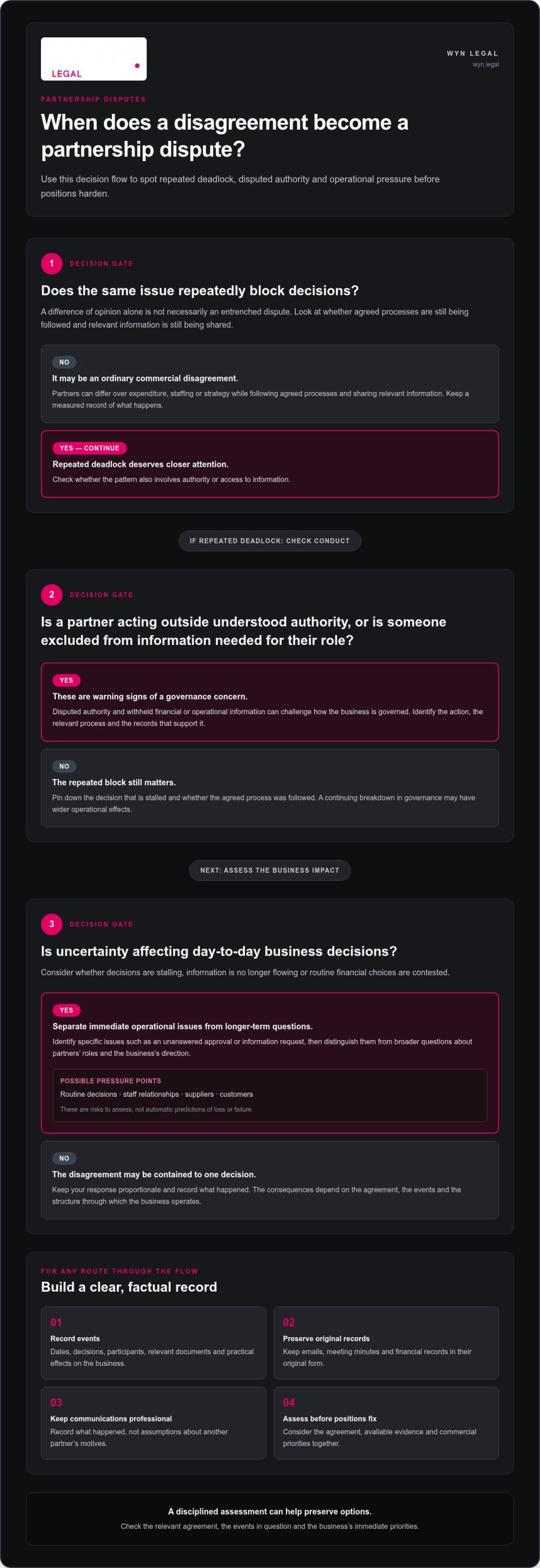
A partnership conflict can affect much more than the relationship between partners. Decisions may stall, information may stop flowing and routine financial choices can become contested, putting pressure on staff, suppliers and customer relationships. Start by identifying what is at risk, then respond with a clear record of events and an understanding of the business’s immediate priorities.
A partnership dispute is a disagreement between partners over their rights, duties or control of the business. It may involve disputed authority, withheld financial or operational information, disagreements about profit allocation, or decisions made unilaterally. A difference of opinion is not necessarily an entrenched dispute. Repeated deadlock or a pattern of conduct that challenges agreed governance deserves closer attention.
Delay can make events harder to reconstruct and allow uncertainty to affect operations, but not every disagreement requires immediate litigation. An early, disciplined assessment can preserve options. A partnership dispute solicitor can examine the conflict against the agreement, available evidence and commercial priorities before positions become fixed.
Recognising a dispute before positions harden
Commercial disagreements are part of running a business. Partners may differ over expenditure, staffing or strategy while still following agreed processes and sharing relevant information. Concern grows when the same issue repeatedly blocks decisions, a partner acts outside their understood authority, or someone is excluded from information needed to carry out their role.
Keep a measured record of dates, decisions, participants, relevant documents and the practical effect on the business. Preserve emails, meeting minutes and financial records in their original form. Keep communications factual and professional. Accusations or threats can harden positions and distract from the issue. Record what happened, not assumptions about another partner’s motives.
The commercial risks behind a partner disagreement
Unresolved conflict can disrupt ordinary decisions, from approving expenditure to agreeing business priorities. It can also strain relationships with employees, suppliers or customers if uncertainty reaches beyond the partnership. Financial decisions may become harder when partners dispute access to information, authority to act or how profits should be treated. These are risks to assess, not automatic predictions of loss or failure.
The consequences depend on the partnership agreement, the events in question and the structure through which the business operates. A disagreement about one decision may be contained; a continuing breakdown in governance may have wider operational effects. Separate immediate issues, such as an unanswered approval or information request, from longer-term questions about roles and the business’s direction. This helps keep your response proportionate.
For context, the Uniform Partnership Act (UPA) and Revised Uniform Partnership Act (RUPA) describe partnership frameworks in the United States. They are not the governing rules for a UK partnership, so they should not be treated as a guide to UK rights. Assess the relevant position under the applicable UK legal framework and the partnership’s own arrangements.
How the partnership agreement and legal framework shape your position
Start with the governing documents, not assumptions about what is fair. A partnership agreement may set out who can make decisions, how profits are allocated, what happens when a partner retires and how disputes should be handled. These terms can shape both your legal position and the practical options for keeping the business functioning.
Your rights depend on the agreement, the business structure and the law that applies to the partnership. The Partnership Act 1890 may supply default rules where an agreement does not resolve an issue, but its relevance must be considered alongside the facts and jurisdiction. A company or limited liability partnership (LLP) has a different legal structure from an ordinary partnership, so its governing documents and applicable rules may differ.
What to examine in a partnership agreement
Review clauses on decision-making authority, access to accounts, profit shares, retirement and dispute resolution. Check amendments, side agreements and records of how the partners have acted, as these may affect how a provision applies. Read each clause in the context of the full document and surrounding facts, rather than interpreting a disputed phrase in isolation.
Look at the process required for each type of decision. For example, an agreement may distinguish ordinary business decisions from matters requiring a particular approval. A dispute about whether the process was followed is different from a disagreement about the merits of the decision itself. Identify the clause, the action taken and the supporting records before forming a view on whether a right may have been breached.
Structure matters. A business described informally as a partnership may operate through a limited company or an LLP, each with its own legal identity and governing framework. Do not assume that the word “partner” in everyday use establishes the legal structure. Confirm which entity holds assets, enters contracts and conducts the business, then assess the relevant documents accordingly.
When there is no written agreement or its terms are disputed
No signed agreement does not, by itself, determine whether a partnership exists. The parties’ arrangements and conduct may be relevant, while statutory default rules may govern matters left unresolved by their terms. The Partnership Act 1890 may be a source of those rules, but its application and interaction with the facts require jurisdiction-specific analysis.
Jurisdiction is not a technical afterthought. Partnership law may differ across the UK, and the legal form of the business can affect which rules apply. A partnership dispute solicitor can assess the documents, conduct, structure and applicable law together, rather than relying on a single clause or assumption. WYN Legal’s partnership dispute advice can help establish your position and its commercial implications.
Compare negotiation, mediation and litigation in a partnership dispute
There is no universally correct route. The choice depends on the evidence, urgency, relationship between the partners and the outcome the business needs. Check the partnership agreement first: it may prescribe steps or a sequence for resolving disputes, which can influence the available options.
The comparison below is a starting point, not a substitute for assessing the specific facts. Confidentiality differs between routes and should be considered in light of the process, any agreement between the parties and the applicable rules.
| Route | Control and process | Confidentiality and relationship impact |
|---|---|---|
| Negotiation | Partners have direct control over proposals, timing and terms, but progress depends on their willingness to engage. | Discussions may be kept private in practice, although the handling and later use of communications depend on the circumstances. A constructive approach may preserve working ties; an unmanaged exchange can harden positions. |
| Mediation | An independent mediator facilitates discussion but does not decide the dispute. The partners control whether to agree terms. | Provides a structured setting for sensitive issues. It can support continued business relations, but settlement is not guaranteed and confidentiality depends on the process and arrangements. |
| Litigation | The court manages formal proceedings and can determine issues within its jurisdiction. The parties have less control over timetable and outcome. | Proceedings involve formal procedural demands and may intensify conflict. Court records and hearings may be public, subject to applicable rules and any order. |
When negotiation or mediation may serve commercial priorities
Structured discussion can help partners resolve a specific operational problem, such as stalled approvals, while retaining control over practical terms and future business arrangements. Mediation adds an impartial facilitator who can help the parties test proposals and narrow disagreements. The mediator does not impose a settlement.
These routes may not be enough on their own if a party refuses meaningful engagement, evidence needs protection or urgent action is required. Define the issue, preserve relevant records, agree who can negotiate and avoid treating discussion as a substitute for protecting immediate legal or commercial interests. A partnership dispute solicitor can help assess these risks and the agreement’s procedures before you choose a route.
When court proceedings may need consideration
Proceedings may warrant consideration where deadlock is entrenched, urgent protection is needed or the dispute requires a binding determination. They involve formal steps, evidence, timetables and cost exposure, all of which need tailored assessment. Litigation is an option, not an automatic next step, and no particular result can be assumed.
For wider commercial context, WYN Legal’s business dispute solicitors strategic guide considers how resolution strategy connects with business priorities. Choose a route to serve the objective, rather than letting the process dictate it.
Prepare for a partnership dispute solicitor: documents, objectives and risks
Preparation makes advice more precise. A partnership dispute solicitor can assess your position more effectively when the documents, sequence of events and commercial priorities are clear. Organise the material you already hold, preserve it in its original form and do not try to obtain records through access you are not authorised to use.
Work through this sequence:
- Preserve relevant records. Keep the partnership agreement, amendments, accounts, correspondence, meeting records and documents relating to disputed business decisions. Retain original files and note where each item came from. Do not edit, delete or annotate the only copy.
- Identify the clauses in issue. Mark provisions that relate to the disagreement, such as decision-making, access to accounts, profit allocation, dispute procedures or exit arrangements. Record the question each clause raises, rather than treating your interpretation as settled.
- Map the events. Build a dated chronology of key decisions, communications and disputed actions. Link each entry to supporting documents where possible, and separate what you directly witnessed from what you inferred or later recalled.
- Define your objectives and risks. Distinguish the outcome you prefer from protections you consider essential and compromises you could accept. Identify operational issues that may need prompt legal assessment, such as uncertainty over authority to approve a necessary business decision.
Build a clear factual record
Keep the chronology concise and neutral. Record who was involved, what happened, when it occurred and the effect on the business. Preserve relevant emails, messages, accounts and meeting notes without changing their context. List potential witnesses and the records they may hold, but do not approach people in a way that could inflame the dispute or compromise evidence.
Keep communications with the other partner proportionate and factual. State the issue and any information needed without allegations or threats. A disciplined record helps distinguish documented facts from assumptions and gives legal advice a firmer foundation.
Define the outcome the business needs
Set out what must be protected, what you hope to achieve and what could be negotiated. Consider continuity of trading, management authority, treatment of business assets and whether a partner exit is an option. These are separate questions: an immediate safeguard may be essential even while the longer-term outcome remains open.
Make the business structure clear. If the dispute concerns a company’s shares or shareholder rights rather than a partnership, the shareholder dispute resolution guide may be relevant. WYN Legal advises on partnership disputes, connecting assessment of the evidence and legal position with the commercial outcome you need. Discuss your partnership dispute with WYN Legal to assess your position and next steps.
How a partnership dispute solicitor can build a strategic route forward
Effective advice connects legal rights to commercial reality. A partnership dispute solicitor can examine the agreement, evidence and applicable law alongside what you need to protect, whether that is continuity of trading, decision-making authority, a workable partner relationship or a structured exit. The aim is not simply to identify points of conflict. It is to understand your position, the risks attached to each option and the decisions that should come next.
WYN Legal advises on partnership disputes as part of its litigation and dispute-resolution work. The right strategy depends on the facts, and no route guarantees a particular outcome. Clear analysis can still replace uncertainty with a considered plan.
What strategic legal advice should address
Advice should distinguish established facts from disputed allegations and identify where the agreement, records or applicable law leave uncertainty. It should also surface practical risks, such as an unresolved authority question affecting a key business decision, so these can be assessed in context rather than treated as abstract legal points.
Each route can then be tested against business continuity, control, cost exposure and your desired outcome. That assessment should clarify the next steps, the information needed and how communications can be managed without unnecessarily narrowing your options.
A disciplined assessment may address:
- Position: what the documents and evidence indicate about your rights and obligations.
- Exposure: the legal, operational and commercial risks that need attention.
- Objectives: which outcomes are essential, preferred or open to compromise.
- Route: what process best fits the facts, urgency and partnership arrangements.
This joined-up approach matters because legal strength alone does not define a commercially sound decision. A proposed step may protect one interest yet create operational pressure elsewhere. Advice should make those trade-offs visible before you commit.
Move from uncertainty to a considered decision
Bring the partnership agreement and any amendments, relevant accounts and correspondence, meeting records, and a concise chronology of the events in dispute. Identify the decisions or protections that matter most, alongside the questions you need resolved. An organised starting point helps focus advice on the material issues and reduces time spent reconstructing the background.
Early advice can inform decisions while there is still room to shape communications and consider options. It does not require you to begin court proceedings or commit to a settlement route. It gives you a clearer basis for deciding what to protect, what further evidence matters and how to proceed in the business’s interests.
WYN Legal provides strategic support for partners assessing their rights, risks and resolution options. Discuss your partnership dispute with WYN Legal to assess your position and identify a considered next step.
Take control of the next decision
The next move can shape more than the dispute. It can influence how the business operates, how partners communicate and what options remain open. A considered legal assessment helps turn immediate pressure into a decision that takes the business’s longer-term interests into account.
WYN Legal handles partnership disputes as part of its dispute-resolution work. A partnership dispute solicitor can help assess the issues and identify a proportionate next step, without assuming negotiation, mediation or court proceedings will suit every situation. Lawful Limited, WYN Legal’s trading name, is authorised and regulated by the Solicitors Regulation Authority, SRA number 829708.
Bring the agreement, key records and a clear account of what you need to protect. You do not need to have resolved every uncertainty before seeking advice. A focused discussion can help establish what matters now and where to direct your attention next.
Discuss your partnership dispute with WYN Legal and take a considered step towards protecting your business interests.
Frequently Asked Questions
Is a verbal partnership agreement legally binding?
Yes, a verbal arrangement can be legally binding, and a partnership may also be inferred from conduct even if no terms were formally signed. The difficulty is proving what was agreed, such as whether profits were to be divided equally or one partner could approve particular spending. Preserve relevant messages, draft accounts and payment records. Before relying on an alleged term, have the evidence and applicable jurisdiction assessed.
Can a partner be expelled from a business partnership?
Not automatically. Expulsion depends on whether the partnership agreement gives a power to remove a partner and whether its conditions have been met. A majority vote or breakdown in trust does not, by itself, establish a right to expel someone. Check whether the clause sets grounds, notice requirements, voting thresholds or a response process. Seek advice before changing a partner’s role, access or status, as a flawed step may trigger further disputes.
Can one partner bind the partnership to a contract?
Potentially. A partner may have authority to bind the firm in the ordinary course of its business, but the answer depends on the transaction, the partner’s authority and the applicable law. A routine supplier order may raise different issues from an unusual sale of a major business asset. Review the contract, any communications about authority and the identity of the contracting entity before treating the agreement as unauthorised.
What happens if a partner leaves without an agreed exit process?
A partner’s departure does not necessarily end the partnership or settle all outstanding rights and obligations. Depending on the agreement and applicable law, accounts may need to be prepared, an interest assessed and existing commitments considered. For example, leaving may not by itself release a partner from a guarantee or contract already entered into. Avoid transferring business property or announcing a final exit until the legal and commercial position has been assessed.
Can a partnership dispute be resolved without going to court?
Yes. Direct negotiation, a procedure in the partnership agreement or mediation may resolve a dispute without a court determination if the partners can engage and agree workable terms. A mediator facilitates discussion but cannot compel settlement. If talks fail, or the dispute requires urgent protection or a binding ruling, court proceedings may need consideration. A partnership dispute solicitor can help assess which route fits the evidence and the business’s practical priorities.
Are partners personally liable for partnership debts during a dispute?
Potentially, but a dispute alone does not determine liability. The answer depends on the business structure, who entered into the obligation, its terms and the applicable law. Internal arrangements between partners may not determine a creditor’s rights. Identify the entity named in the contract and preserve invoices, guarantees and related correspondence. Take advice before admitting responsibility or making a payment on behalf of another partner.