

Property dispute legal options: routes to resolution in 2026
October 11, 2026
A dilapidations schedule can call for action without proving that every listed item is the tenant’s responsibility. Receiving an interim schedule of dilapidations may feel like an instruction to repair everything immediately, but the schedule itself does not determine what the lease requires or whether each allegation is justified. The lease wording, the property’s condition and the available evidence all matter.
That uncertainty cuts both ways. Tenants who ignore a schedule risk weakening their position; landlords who rely on unsupported or overstated items risk undermining enforcement. A measured response starts with the documents and evidence, not assumptions.
This guide explains the purpose and limits of an interim schedule, how it differs from a terminal schedule, and what may follow if a tenant disputes the allegations or takes no action. It also explains how to assess each item against the lease, a schedule of condition and other evidence, then decide on a proportionate response. Where a landlord seeks to enforce repairs, the relevant lease provisions and remedies need careful examination. WYN Legal advises landlords and tenants on dilapidation disputes through evidence-led assessment and commercially informed strategy.
Key Takeaways
- An interim schedule of dilapidations identifies alleged breaches during a tenancy; its effect depends on the lease and the facts.
- Repair, decoration, reinstatement and other covenant issues may appear, but listing an item does not establish liability or the appropriate remedy.
- Distinguish an interim schedule from a terminal schedule by considering when it is served and what remedy the landlord seeks.
- Review the lease, inspect each allegation and gather relevant evidence before preparing a reasoned response. Address any stated deadlines promptly.
- Evidence-led legal analysis helps landlords and tenants separate defensible obligations from disputed allegations and pursue a proportionate strategy.
What is an interim schedule of dilapidations, and what does it mean?
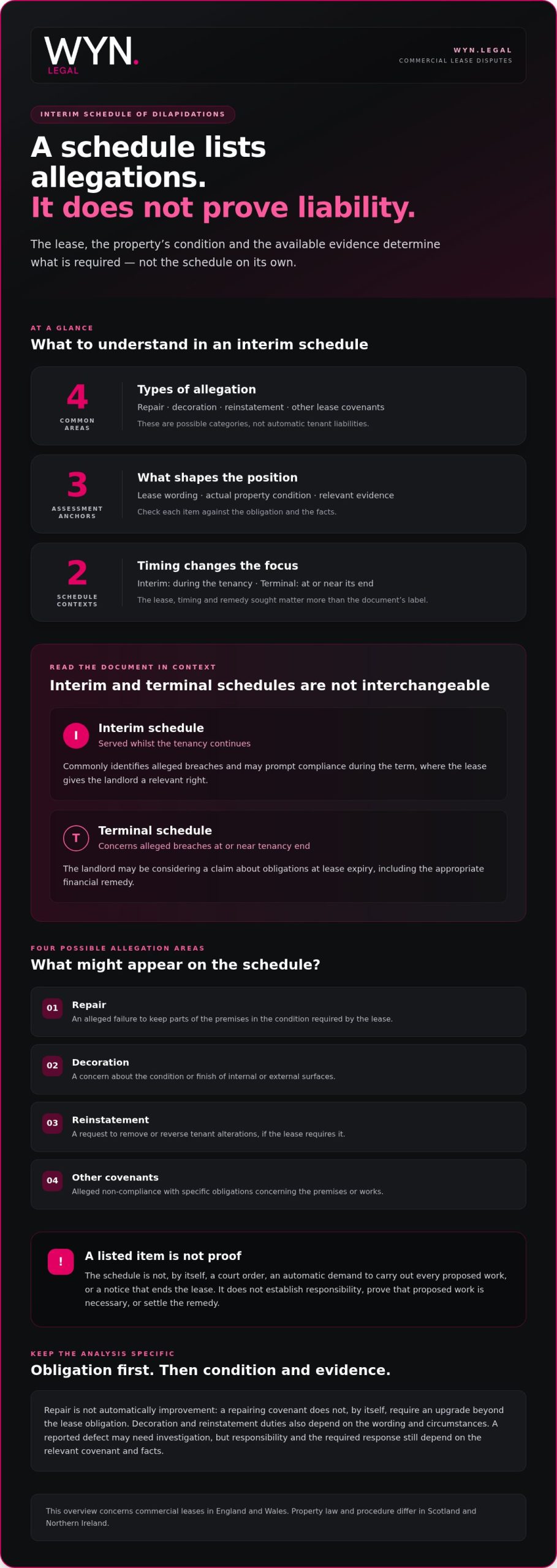
An interim schedule of dilapidations is a document served by a landlord during an ongoing tenancy. It identifies alleged failures to comply with lease obligations, often relating to the repair or condition of the premises, and may describe works the landlord says are needed. It sets out allegations to assess, not proof that the tenant is liable for every item.
The distinction matters. A schedule is not, by itself, a court order, an automatic demand to carry out every proposed work, or a notice that ends the lease. Its significance depends on the lease wording, the alleged breach, evidence about the property and the remedy the landlord is entitled to pursue. For example, a reported leak may need urgent investigation, but responsibility and the required response still depend on the relevant covenants and facts.
This section focuses on commercial leases in England and Wales. Property law and procedure differ in Scotland and Northern Ireland, so the analysis should not be assumed to apply across the whole UK. For a general introduction to the terminology, see Dilapidations Wikipedia. The lease and applicable law remain central to any particular dispute.
Interim versus terminal schedules: the key distinction
An interim schedule may be served whilst the tenancy continues, potentially years before the contractual end date. Its practical purpose is commonly to identify alleged breaches and prompt compliance during the term, where the lease gives the landlord a relevant right. A terminal schedule, by contrast, addresses alleged breaches at or near the end of the tenancy, when the landlord may be considering a claim relating to the tenant’s obligations at lease expiry.
The two documents are not interchangeable. An interim schedule may focus on specified works whilst the tenant remains in occupation; a terminal dispute may concern the landlord’s loss and the appropriate financial remedy after the tenancy ends. The document’s label alone does not decide the legal position. The lease terms, timing and remedy sought must be examined.
Why a landlord may serve an interim schedule
Early identification can help protect the property and give the tenant an opportunity to address alleged breaches before they worsen or remain unresolved at lease expiry. For example, raising a repair concern during the tenancy gives the parties time to investigate its cause, agree an appropriate scope of work and arrange access without the added pressure of an imminent departure.
However, listing work does not give the landlord an automatic right to compel it. The schedule may alert the tenant to the landlord’s position, but the lease determines whether the tenant must act, what standard applies and which enforcement routes are available. Some leases contain specific mechanisms for a landlord to require repairs or, in defined circumstances, carry them out and seek to recover the cost. Those rights depend on the actual wording and facts, not on the schedule alone.
The lease determines the schedule’s significance: it defines the relevant obligations and the remedies that may follow from an established breach.
What can an interim schedule of dilapidations include?
An interim schedule of dilapidations may identify alleged breaches across several parts of a commercial lease. The landlord’s surveyor will commonly describe the location and condition complained of, refer to the relevant lease obligation and set out proposed remedial work. For example, a schedule might identify damaged finishes in a particular room or a defect to an external element, then describe the work the landlord considers necessary.
Common categories include:
- Repair: alleged failures to keep parts of the premises in the condition required by the lease.
- Decoration: concerns about the condition or finish of internal or external surfaces.
- Reinstatement: requests to remove or reverse tenant alterations, where the lease requires this.
- Other covenants: alleged non-compliance with specific obligations concerning the premises or works.
These are categories, not automatic liabilities. An item on a schedule does not prove the tenant is responsible, establish that the proposed work is necessary or settle what remedy is available. The lease wording and the property’s actual condition take priority over generic descriptions.
Alleged disrepair, decoration and reinstatement
Repair and improvement are not interchangeable. A repairing covenant may require the tenant to maintain or restore an item to the standard specified by the lease, but it does not automatically require an upgrade beyond that obligation. The precise wording, the item’s condition and relevant evidence shape the analysis.
Decoration obligations may specify particular requirements or apply in certain circumstances, so read their scope from the lease rather than assume it. Reinstatement allegations also depend on the terms governing alterations: one lease may require the removal of particular works, whilst another may treat the issue differently. A partition, changed lighting layout or altered floor finish can illustrate the type of issue raised, but none carries a universal obligation to reinstate.
Evidence behind each item
Test every allegation against the lease wording and the evidence. Bring together the lease and any relevant plans, dated photographs, inspection records, maintenance documents and correspondence about the property’s condition or proposed works.
Descriptions should be precise enough to locate and assess the alleged defect. “Damage to wall” may leave too much unanswered. Identifying the room, wall, nature and extent of the damage gives both sides a clearer basis for investigation and response. Compare photographs over time, check whether records show earlier reports or repairs, and distinguish visible condition from assumptions about its cause. If the schedule proposes extensive work, assess whether the stated defect supports that scope instead of treating the recommendation as established fact.
Keep the material organised by item. This makes it easier to identify what is accepted, what needs inspection and what is disputed, while preserving a clear record for discussion with the landlord. Where the schedule raises contested obligations, dilapidation dispute advice can help connect the evidence to the lease and the commercial position.
Does an interim schedule mean the tenant must immediately do every listed item?
No, not automatically. Receiving an interim schedule of dilapidations does not prove that every allegation is correct, that the tenant is responsible or that every proposed work must be carried out immediately. But the schedule should not be ignored. It may identify a genuine breach, draw attention to a time-sensitive issue or signal that the landlord intends to rely on rights in the lease.
The right response is neither automatic acceptance nor blanket rejection. Assess each item against the lease, the condition of the premises and the evidence. A tenant may dispute whether the defect exists, whether the relevant covenant applies, whether the tenant is responsible for it or whether the proposed work goes beyond what the lease requires. The landlord may, in turn, have a valid basis to seek compliance or pursue a remedy. The outcome depends on the wording and circumstances.
What the schedule does not decide
A schedule is not a final judicial determination of liability. It records the landlord’s position but does not resolve disputed facts or establish the correct interpretation of a covenant. A tenant can challenge an item’s factual basis, the obligation relied on or the scope of the proposed remedy, whilst recognising that some items may warrant prompt action.
Separate the landlord’s request from the remedy potentially available. During the term, the landlord may be seeking performance of a repair obligation rather than damages. Some leases also contain express provisions allowing a landlord, in defined circumstances, to carry out specified works and seek to recover the cost. Whether such a mechanism applies depends on the clause and the facts. A schedule should not be treated as a damages award or as authority to charge any amount the landlord chooses.
How lease terms affect potential remedies
Start with the exact covenant and any clause dealing with inspection, access, repair notices or landlord intervention. The lease may prescribe steps the landlord must take, allow a period to remedy a breach or set conditions for further action. Do not assume a standard timetable or remedy applies simply because a schedule has been served.
Enforcement may have serious consequences. Forfeiture is not an automatic result of an alleged breach; the landlord’s right to pursue it and the steps required depend on the lease, the breach and applicable law. Statutory notice requirements and the consequences of enforcement need careful, fact-specific legal analysis before either party acts. A tenant should not assume that a disagreement suspends all obligations, and a landlord should not assume that listing an item satisfies every legal or contractual requirement.
Preserve the schedule, lease, correspondence and relevant inspection records, then obtain advice before taking a step that could affect occupation or liability. WYN Legal’s dilapidation dispute advice helps landlords and tenants assess the wording, evidence and available remedies against their commercial objectives.
How should a tenant assess and respond to an interim schedule?
Respond methodically. A rushed admission can concede more than the lease requires; a blanket denial can weaken a credible position. Treat the schedule as a set of separate allegations and build a record that explains the tenant’s position on each one.
Start by noting any response date or action requested in the landlord’s letter. There is no universal response period for every interim schedule, so check the stated deadline against the lease and circumstances. If an item raises an urgent safety or property-protection concern, deal with it separately and promptly whilst preserving the tenant’s position on responsibility and scope.
Review the lease and inspect the alleged breaches
Work through the schedule item by item. Match each allegation to the covenant the landlord relies on, then check any relevant plan, licence, alteration consent or other lease document. Inspect the identified area against the description and compare its current condition with dated photographs, inspection records, maintenance documents and earlier correspondence. If access or specialist evidence is needed, record what remains unverified rather than treating an assumption as fact.
Classify every item clearly:
- Agreed: the obligation and condition are accepted, with the proposed action considered separately.
- Disputed: the tenant contests the facts, responsibility, lease interpretation or extent of work, and records why.
- Unclear: further inspection, documents or expert evidence are needed before a position can properly be taken.
This distinction helps keep genuine obligations from being lost in a general dispute. It also highlights gaps in the landlord’s case and helps the tenant prioritise items that may worsen if left unresolved.
Prepare a controlled response and resolution strategy
Answer each allegation directly. Identify the item, state whether it is accepted, disputed or under investigation, and give the reason, supported by documents where available. If the description is too vague to assess, specify what information or access is needed. Avoid conceding liability simply by discussing practical arrangements for inspection or work; make the tenant’s position clear in writing.
Then decide what advances the commercial and legal position. This may mean carrying out an accepted repair, obtaining further evidence, challenging an excessive scope or negotiating a practical programme of works. Keep records of inspections, instructions, completed work and communications. If the dispute continues, a structured item-by-item response gives negotiations a firmer basis than broad assertions.
A prompt, item-by-item response preserves evidence, clarifies disagreements and keeps the tenant’s options open. The Dilapidations Protocol is directed to claims for damages concerning the physical state of commercial property at the end of a tenancy, so do not assume it governs every interim dispute. Clear, early communication remains a disciplined approach.
For a strategy grounded in the lease, evidence and commercial priorities, advice on a dilapidation dispute from WYN Legal can help.
How WYN Legal approaches interim schedule of dilapidations disputes
A schedule needs more than a quick acceptance or rejection. WYN Legal advises landlords and tenants in dilapidation disputes, assessing the document against the lease, available evidence and the client’s commercial objectives. The aim is to establish what the lease requires, what remains genuinely contested and which response best protects the client’s position.
That analysis is practical as well as legal. A tenant may need to weigh the cost and disruption of proposed works against the strength of the alleged obligation; a landlord may need to test whether the schedule clearly identifies the breach and supports the remedy sought. Neither party benefits from treating every item as settled before that assessment is complete.
Evidence-led assessment of the schedule
WYN Legal examines each allegation alongside the relevant lease wording, inspection material, photographs and correspondence. This helps identify where evidence supports an obligation, where the parties interpret a covenant differently, and where further information or inspection is needed before a firm position is taken.
The review considers both legal exposure and practical consequences. It does not assume that a landlord’s proposed work is automatically required, or that a tenant’s disagreement removes an obligation. Each item must stand on its own evidence and contractual basis.
Decisive advice on the route forward
Once the issues are clear, advice can focus on the available routes: comply with an established obligation, seek clarification or further evidence, negotiate a proportionate scope, or contest an allegation or remedy. The appropriate course depends on the lease, evidence, relevant deadlines and the commercial impact of delay or disruption.
For landlords, a disciplined approach helps ensure that demands are grounded in the lease and supported by the available material. For tenants, it helps distinguish defensible obligations from disputed items and avoid unnecessary concessions. In either case, clear, carefully framed communication can support negotiations while preserving the client’s position if formal dispute steps become necessary. No particular outcome can be assumed in advance.
WYN Legal tailors its advice to the dispute rather than relying on a standard response. A focused assessment of an interim schedule of dilapidations brings the lease, evidence and commercial priorities into one clear strategy, so the next step is deliberate and proportionate.
WYN Legal’s advice on dilapidation disputes addresses the lease, evidence and commercial position.
Take control of the next step
The next move should be deliberate. Before agreeing to works, rejecting allegations or allowing a dispute to drift, make sure your position is supported by the lease, the evidence and a clear view of the commercial consequences. An interim schedule of dilapidations can affect important decisions during a tenancy, but a considered response keeps those decisions grounded in the facts.
WYN Legal advises on dilapidation disputes as part of its property litigation work. The firm is authorised and regulated by the Solicitors Regulation Authority, SRA number 829708. Advice helps landlords and tenants assess their position and determine a proportionate route forward, without assuming that negotiation or formal proceedings will produce a particular result.
Discuss an interim schedule of dilapidations with WYN Legal and take the next step with a clear, commercially informed strategy.
Frequently Asked Questions
Is an interim schedule of dilapidations legally binding?
No. The schedule itself is not a court judgment or an agreement that makes every listed item binding on the tenant. However, the lease may impose obligations independently of the schedule, and a landlord may have contractual or legal remedies if a breach is established. Before deciding how to respond, check whether the document is accompanied by a formal notice, what action it requests and which lease provisions it relies on.
Can a landlord serve an interim schedule during a commercial lease?
Yes, a landlord can identify alleged breaches during an ongoing commercial tenancy. Whether the landlord can require particular works or take further action depends on the lease and the facts, rather than the document’s title. For example, a lease may provide inspection or repair-enforcement rights, whilst another may not contain the same mechanisms. Review access provisions and relevant notice requirements before arranging an inspection or carrying out work.
What is the difference between an interim and terminal schedule of dilapidations?
An interim schedule concerns alleged breaches raised whilst the tenant remains in occupation; a terminal schedule concerns the property’s condition at or near the end of the tenancy. That timing can affect the landlord’s objective, the evidence available and the remedy in issue. For instance, a tenant still operating from the premises may need to plan access around business activity, whereas an end-of-tenancy dispute may focus on the condition at handover.
How long do I have to respond to an interim schedule of dilapidations?
There is no single response period for every interim schedule. Check the landlord’s covering letter, any deadline in the lease and whether the request is framed as a formal notice requiring action. Do not assume that silence is harmless or that a stated date can be disregarded. If the deadline is unclear or cannot reasonably be met, seek advice promptly and explain what further information or inspection is required.
Can a tenant dispute items in an interim schedule?
Yes. A tenant can challenge an item because the alleged defect is not present, the cited covenant does not impose that obligation, or the proposed work appears broader than the lease requires. Identify the specific item and explain the basis of the disagreement, supported where possible by inspection records or photographs. A reasoned response can distinguish between items accepted, contested and needing further investigation.
Does the Dilapidations Protocol apply to an interim schedule?
The Dilapidations Protocol addresses claims for damages relating to the physical state of commercial property at the end of a tenancy; it does not strictly govern every interim schedule dispute. Its emphasis on clear communication and engagement may still inform sensible conduct, but do not assume every protocol step applies. Identify whether the dispute concerns in-term compliance or a terminal damages claim before relying on protocol requirements.
Can an interim schedule lead to forfeiture of a commercial lease?
Not by itself. Forfeiture depends on the landlord’s rights under the lease, the nature of the alleged breach and compliance with applicable contractual and legal requirements. A schedule does not automatically end the tenancy. If a landlord threatens forfeiture, or a tenant receives a formal notice connected with enforcement, obtain urgent advice before acting or allowing a deadline to pass, as the consequences may affect occupation and the parties’ available options.